— 8 MIN
The Modern Financial Analyst: How an Automated Proposal Generator Transforms Client Acquisition
Discover how an automated proposal generator transforms financial advisor client acquisition — turning a 3–6 hour manual workflow into a 10-minute competitive advantage. Learn what every winning client proposal must include, and how Genesis Risk Monitor's Proposal Builder delivers institutional-grade outputs with full white-label branding.
Picture this scenario: You have just finished a highly productive initial meeting with a prospective client. Before leaving, they hand you a stack of statements representing their entire life’s savings and current investments. You have not won their business yet — and what you do with those statements over the next 48 hours will likely determine whether you do.
In the highly competitive wealth management industry, trust is won through competence, but it is demonstrated through presentation. A financial analyst cannot simply tell a prospect their portfolio is poorly optimised. They must prove it — visually, analytically, and professionally.
This is where a well-crafted financial proposal becomes the ultimate client acquisition tool. Building these documents manually, however, absorbs hours that should be spent in front of clients. For the modern financial advisor, leveraging an automated proposal generator is no longer a productivity enhancement — it is a structural competitive necessity.
Why a Professional Portfolio Proposal Is the Most Important Document You Produce
A portfolio proposal is your business case to the client. It is the bridge between their current financial frustration and your proposed solution — and it is often the single document that determines whether a new client relationship begins.
When a prospective client is interviewing multiple advisors simultaneously, the one who delivers the most coherent, data-driven, and visually compelling presentation almost always wins the mandate. The implicit message a well-constructed proposal sends is direct: this is the standard of thinking you receive when you work with me.
A professional proposal achieves three objectives simultaneously:
- It demonstrates deep understanding: It proves you have analysed the prospect’s specific situation rather than delivering a generic sales pitch.
- It clarifies complexity: It translates dense financial data — volatility metrics, correlation structures, drawdown history — into visually digestible insights that a non-specialist client can understand and act on.
- It anchors your value proposition: It makes your analytical rigour and risk management capabilities tangible, justifying your advisory fee before a contract is signed.
The advisor who delivers a polished, data-rich proposal within 24 hours of an initial meeting communicates something their competitor cannot buy: speed, precision, and preparation.
The Essential Components of a Winning Client Proposal
While every advisory practice has its own identity, the core structure of a high-converting financial proposal is consistent across high-performing firms. The following five sections should be present in every client-facing presentation you deliver.
1. Executive Summary and Client Objectives
Begin with the client, not the markets. Clearly state their goals, investment time horizon, risk tolerance classification, and the specific pain points they surfaced in your initial meeting. This section proves you were listening — and ensures the proposal cannot be mistaken for an off-the-shelf template.
2. Current Portfolio Analysis
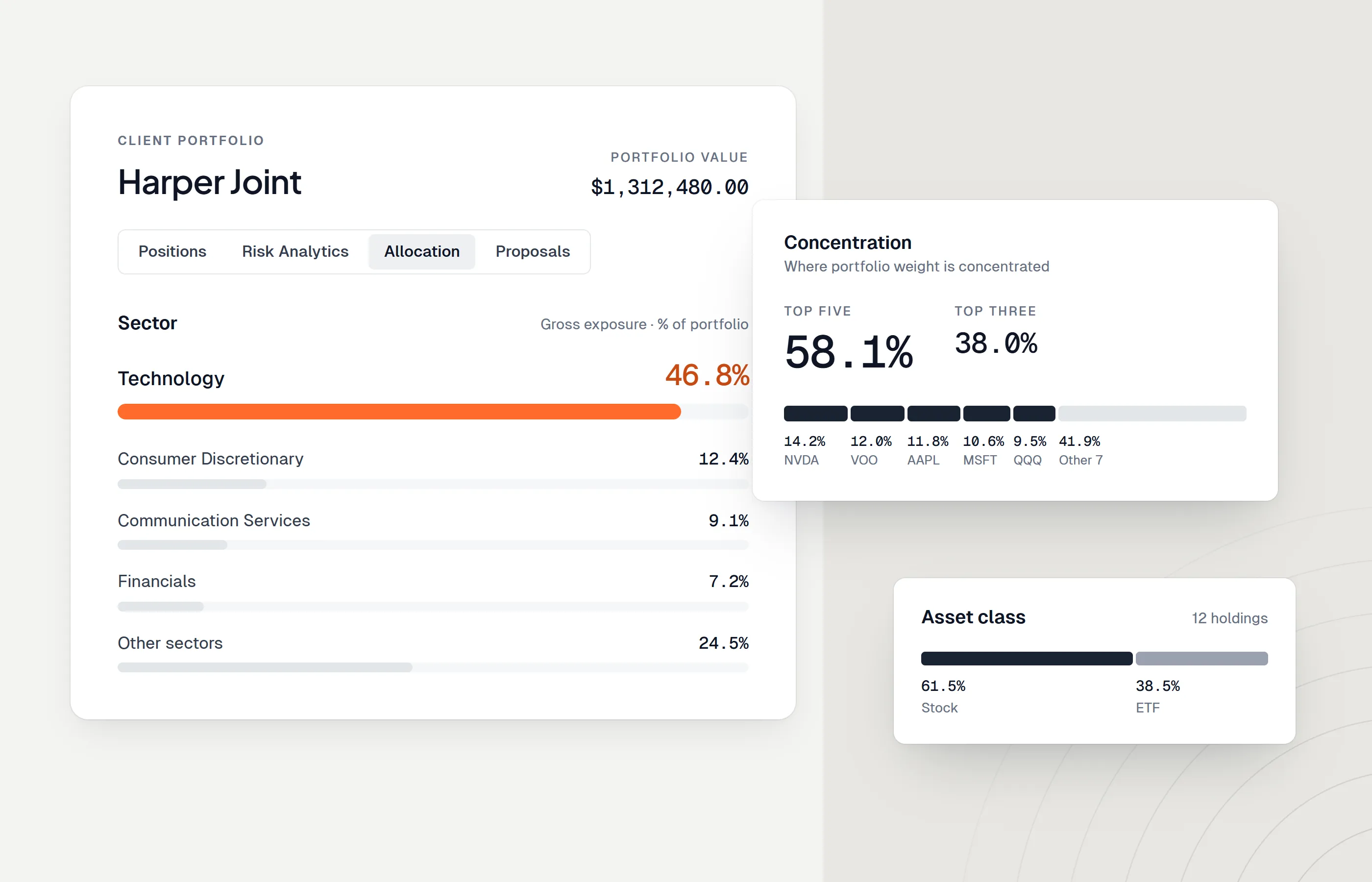
You cannot chart a credible path forward without an honest diagnosis of where the client stands today. This section should provide an objective assessment of their existing holdings: asset class exposure, sector and geographic concentration, historical drawdown behaviour, and hidden risk concentrations they may be entirely unaware of. Presenting analysis the client has never previously encountered is an immediate and durable credibility signal.
3. Proposed Strategy and Asset Allocation
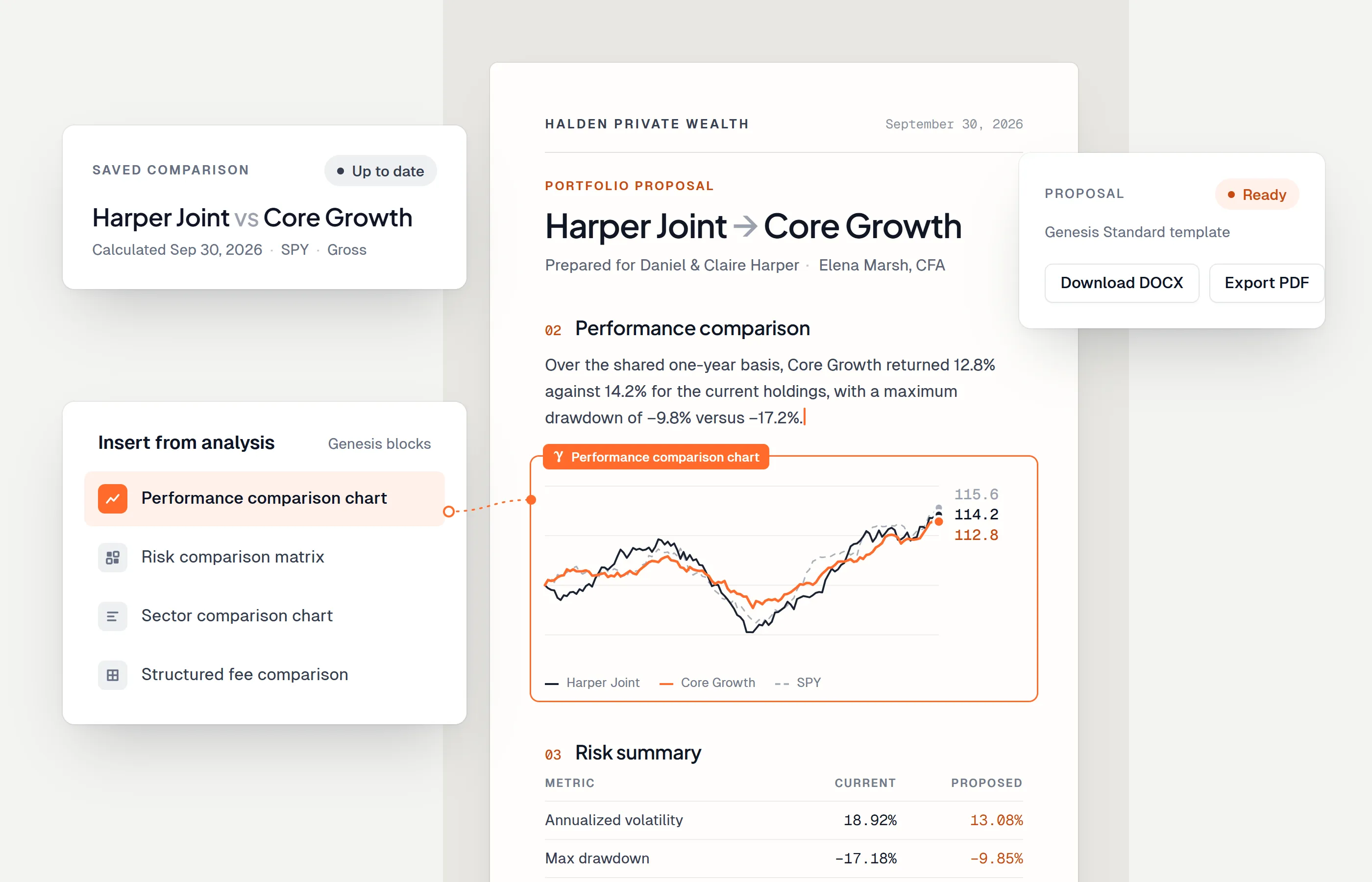
This is the pivot point of the entire document. Present your recommended portfolio side-by-side with their current allocation. Use clear comparative charts to make the improvement in diversification, volatility profile, or projected risk-adjusted return immediately visible. The goal is to render the decision visually obvious before the client has read a single line of explanatory text.
4. Risk and Scenario Analysis
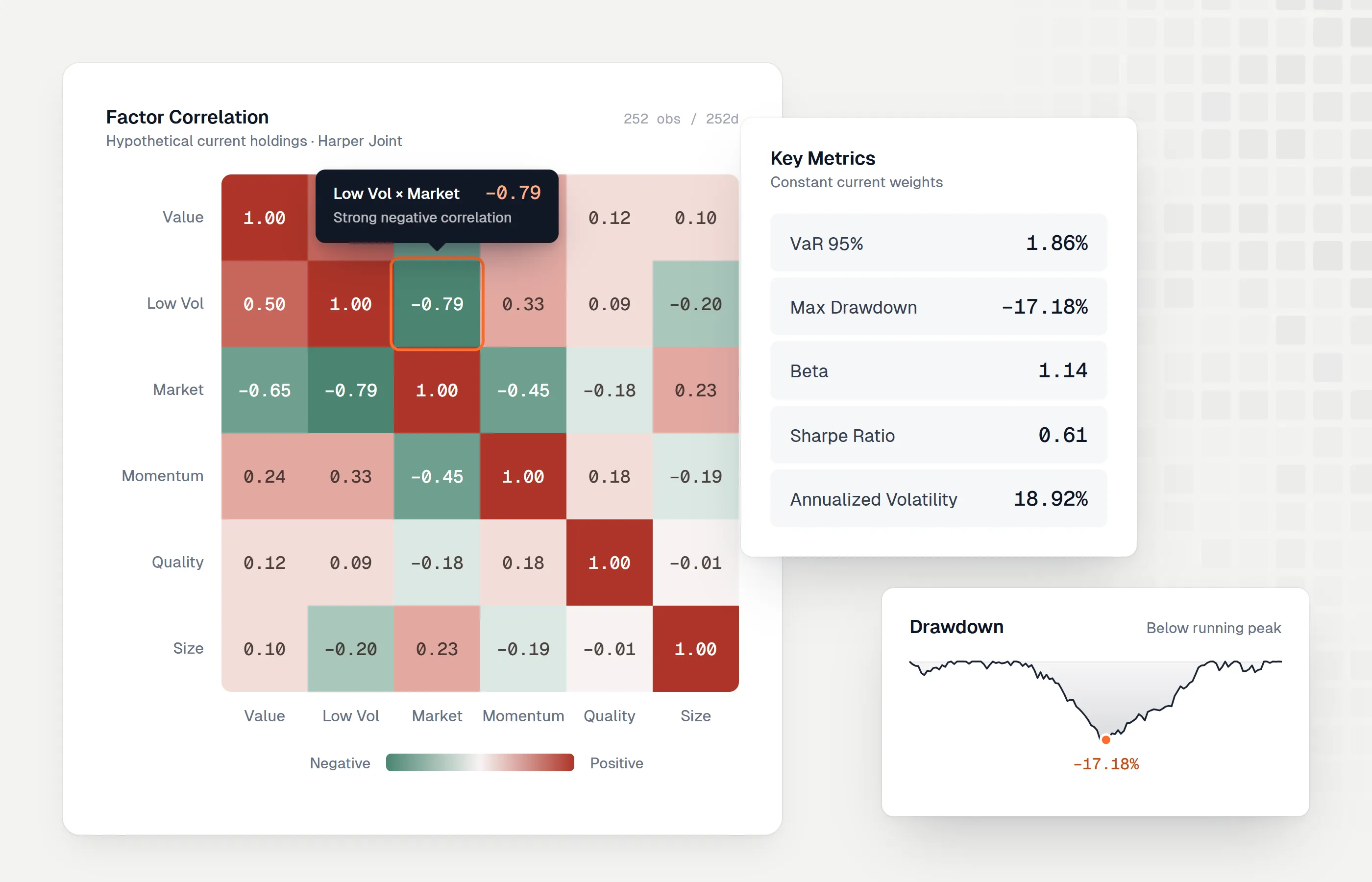
Do not avoid risk — quantify it with precision. Show how your proposed portfolio performs under stress scenarios compared to the prospect’s current setup. Metrics like Value at Risk (VaR) and expected shortfall (CVaR) build substantial credibility by demonstrating you are managing downside risk systematically, not intuitively. Prospects who have not previously encountered this level of analysis will immediately grasp the gap between your offering and a conventional advisory relationship. For a deeper grounding in these concepts, see How to Measure Investment Risk: VaR, CVaR, and Factor Exposure Explained.
5. Transparent Fee Structure and Onboarding Next Steps
Clarity accelerates commitment. Be precise about your fee structure and spell out the exact onboarding steps required to implement the proposed strategy. Reducing friction at the moment of conversion is as important as the quality of the analysis that precedes it.
Manual vs. Automated: The True Operational Cost of Building Client Proposals
To understand why a financial advisor proposal generator is now a competitive necessity rather than a convenience, it helps to compare the two workflows directly:
| Factor | Manual Workflow (Word + Excel) | Automated Proposal Generator |
|---|---|---|
| Time per proposal | 3–6 hours | 10–15 minutes |
| Data entry accuracy | Human error risk (manual ticker entry) | Pulled directly from portfolio data |
| Chart generation | Rebuilt manually for each client | Auto-generated and consistently formatted |
| Brand consistency | Depends on template discipline | Enforced across every output |
| Scenario / VaR analysis | Requires separate tools or manual calculations | Built-in and automatically populated |
| Compliance disclosures | Manually added; risk of omission | Standardised templates; consistently included |
| Scalability under prospect volume | Bottleneck compounds with pipeline growth | Scales linearly without additional time cost |
| Time-to-delivery | 24–72 hours | Same session or within hours |
The cumulative cost of the manual workflow is stark. Across a pipeline of 20 active prospects, a firm building proposals manually absorbs 60–120 hours of non-billable administrative time per cycle — time that could be spent in client-facing conversations, network development, or investment research.
Speed also carries a signal value most advisors underestimate. The faster your turnaround from initial meeting to polished proposal, the higher the prospect’s engagement level when they receive it. Rapid delivery communicates competence before the client has read a single chart.
What to Look for in a Financial Advisor Proposal Generator
Not all automated proposal platforms deliver equivalent value. When evaluating tools, advisory firms should prioritise the following capabilities:
- Institutional-grade risk metrics: Does the platform calculate VaR, CVaR, drawdown analysis, and factor exposure — or only surface-level allocation pie charts?
- True white-labeling: Can you fully replace all third-party branding with your firm’s identity in the final export?
- Portfolio comparison engine: Does it present current vs. proposed portfolios side-by-side in a visually compelling format?
- Stress testing integration: Can you run historically-calibrated scenarios — 2008 credit crisis, 2020 pandemic selloff, rapid rate shock — directly within the proposal workflow?
- Workflow speed: Is data ingestion and output generation fast enough to meet a 24-hour turnaround expectation?
- Compliance-ready structure: Are required disclosures, fee schedules, and methodology footnotes automatically included in every output?
A platform that scores well across all six criteria eliminates the primary operational bottleneck that constrains client acquisition at scale.
Elevate Your Client Presentations with Genesis Risk Monitor
Genesis Risk Monitor provides a dedicated Proposal Builder designed specifically for financial advisors, independent RIAs, and portfolio managers operating in client-facing roles. The platform enables a seamless transition from deep fundamental and risk analysis directly into polished, professional client outputs — without switching tools or reformatting data.
Genesis Risk Monitor automatically generates the comparative allocation charts, risk tables, stress test results, and side-by-side portfolio analyses your proposals require. Full brand customisation — logos, color schemes, and typography — ensures every PDF export positions your firm as a premium, institutional-quality practice. There is no third-party watermark, no generic template aesthetic, and no indication of the underlying platform in the final output.
For independent RIAs and boutique fund managers competing against larger, better-resourced firms, this is a genuine leveling mechanism. The proposals you deliver should be indistinguishable in quality from those produced by a dedicated analyst team — because they are built on the same analytical foundation.
The Proposal Is the Product
In wealth management, the client proposal is not a formality that precedes the real work. For a prospective client who does not yet know you, the proposal is the product — the first genuine evidence of how you think, how you analyse, and how you communicate under pressure.
An automated proposal generator does not replace the advisor’s judgement. It removes the administrative friction that prevents that judgement from being communicated efficiently, professionally, and at scale. The advisors who dominate client acquisition in the years ahead are not necessarily those with the best investment strategies — they are those who can prove it, quickly and compellingly, every single time.
Further Reading:
- How to Measure Investment Risk: VaR, CVaR, and Factor Exposure Explained
- How to Stress Test Your Portfolio
- 6 Essential Risk Analytics Tools for Investors in 2026
Disclaimer: The information provided by ABMS SOFTWARE LIMITED dba Genesis Risk Monitor is strictly for informational purposes only and should not be construed as an offer to sell, a solicitation to buy, or a recommendation for any security or strategy. ABMS SOFTWARE LIMITED dba Genesis Risk Monitor is not a broker or registered investment advisor. Trading in financial markets involves significant risk, and past performance does not guarantee future results.
Frequently asked questions
What is an automated proposal generator for financial advisors?
An automated proposal generator for financial advisors is a software platform that ingests a prospect's current portfolio holdings and a proposed model portfolio, then automatically generates a complete, professionally formatted client proposal — including comparative asset allocation charts, risk metrics (VaR, CVaR, drawdown history), factor exposure analysis, stress test results, and a transparent fee schedule. Platforms like Genesis Risk Monitor's Proposal Builder condense what was traditionally a 3–6 hour manual workflow into under 15 minutes, with fully white-labeled PDF output bearing the advisor's own firm branding.
What should a financial advisor client proposal include?
A complete financial advisor client proposal should include five core sections: (1) An executive summary aligned with the prospect's specific goals, time horizon, and stated risk tolerance; (2) A current portfolio analysis covering asset allocation, sector concentration, historical drawdown, and hidden risk exposures; (3) A proposed strategy with a side-by-side portfolio comparison showing how the new allocation improves the risk-return profile; (4) A risk and scenario analysis section with stress test results and Value at Risk (VaR) metrics; and (5) A transparent fee structure with clearly defined onboarding next steps.
How long does it take to manually build a financial advisor client proposal?
Building a client proposal manually using Word and Excel typically takes 3–6 hours per prospect. This includes downloading position data from custodians, re-entering it into a spreadsheet, formatting comparative charts, calculating risk metrics in separate tools, and assembling the final document. Across a pipeline of 20 active prospects, this represents 60–120 hours of non-billable time per cycle. Automated proposal generators reduce this to 10–15 minutes per proposal, freeing advisors to reallocate that time toward client-facing conversations and business development.
Can I use my own branding in an automated financial proposal?
Yes — the best automated proposal platforms support full white-labeling: custom logos, firm colors, and typography that produce a final PDF appearing to have been crafted entirely in-house by your advisory firm. Genesis Risk Monitor's Proposal Builder supports complete brand customization, enabling boutique advisors and independent RIAs to present client proposals with the same visual quality as institutional asset managers — without revealing the underlying platform.
What is the difference between a portfolio proposal and a financial plan?
A portfolio proposal is a focused, prospect-facing conversion document that demonstrates your analytical capability and the specific improvement your proposed strategy offers over a prospect's current holdings. It is designed to win a new client relationship. A financial plan is broader and deeper — typically produced after a client is onboarded — covering goals-based projections, tax strategy, estate planning, insurance analysis, and long-term cash flow modeling. The proposal wins the client; the financial plan serves them over time.
Does using a standardized proposal generator help with compliance?
Yes. Standardized automated templates significantly reduce compliance risk by ensuring that required regulatory disclosures, fee schedule language, risk methodology footnotes, and legal disclaimers are consistently included in every client-facing document. In a manual workflow, an advisor can accidentally omit a required disclosure when adapting a prior proposal for a new prospect. Automated templates enforce consistent structure across every output, creating an auditable, repeatable process that supports regulatory review.