— 9 MIN
From Prospect Portfolio to Client Proposal: The Complete Financial Advisor Workflow
Learn the complete financial advisor workflow for turning a prospect portfolio into a professional client proposal, from holdings analysis and risk assessment to model comparison and proposal creation.
Before presenting a recommendation, a financial advisor needs to understand what a prospect currently owns, identify the portfolio characteristics that matter, determine how an alternative strategy differs, and communicate those findings clearly.
The challenge is that these steps are often fragmented across multiple systems.
Holdings may be imported into one application. Risk analysis happens somewhere else. Model portfolios are maintained separately. Charts are exported into PowerPoint or Word. The advisor then manually rebuilds the analysis into a client-facing investment proposal.
A more connected prospect-to-proposal workflow brings those steps together.
The objective is not simply to create a proposal faster. It is to create a clear analytical path from the prospect’s current portfolio to the recommendations and comparisons presented in the final document.
The Prospect-to-Proposal Workflow at a Glance
| Stage | Primary objective | Key questions |
|---|---|---|
| 1. Collect portfolio data | Establish an accurate starting point | What does the prospect actually own? |
| 2. Analyze the current portfolio | Understand structure and exposure | Where is the portfolio concentrated? |
| 3. Evaluate portfolio risk | Identify meaningful vulnerabilities | What could materially affect outcomes? |
| 4. Select an appropriate comparison | Define the proposed alternative | Which model or strategy is relevant? |
| 5. Compare current and proposed portfolios | Make differences visible | What changes, improves, or introduces trade-offs? |
| 6. Identify the key narrative | Prioritize relevant findings | What should the prospect understand first? |
| 7. Build and customize the proposal | Turn analysis into communication | How should the findings be presented? |
| 8. Review and update | Confirm accuracy and context | Does the final proposal reflect the latest information? |
Step 1: Start With Accurate Prospect Portfolio Data
Every portfolio proposal begins with the quality of the underlying data.
Prospects may provide custodial statements, CSV files, spreadsheets, investment reports, or manually entered holdings. Before analyzing the portfolio, the advisor should confirm that the available information accurately represents the assets being reviewed.
At minimum, the workflow should identify:
- Securities and funds
- Position values or quantities
- Portfolio weights
- Accounts, when multiple accounts are involved
- Relevant instrument identifiers
Additional information such as cost basis, account type, tax treatment, or currency may also matter depending on the scope of the analysis.
Instrument identification is particularly important. An incorrect ticker, exchange, or security mapping can affect pricing, historical returns, allocation classifications, and risk calculations.
The first question in any professional portfolio analysis should therefore be straightforward:
Are we analyzing the correct portfolio?
Step 2: Understand the Portfolio Before Judging It
Once the holdings are established, the next step is to understand the structure of the current portfolio.
Advisors may review the portfolio by:
- Asset class
- Individual position
- Sector
- Geography
- Currency
- Fund or security type
This first view provides the foundation for deeper portfolio analysis.
The goal should not be to immediately search for weaknesses. Instead, the advisor should build an objective picture of how the portfolio is constructed.
A portfolio containing 40 positions may still be highly concentrated. Multiple funds can hold many of the same underlying companies. Securities that appear diversified by name may be exposed to similar economic risks.
Understanding these relationships requires looking beyond a simple list of holdings.
Step 3: Identify the Risks That Actually Matter
Portfolio risk analytics can produce dozens of metrics, but not every measure belongs in every prospect conversation.
A practical risk review may examine:
Concentration
How dependent is the portfolio on its largest holdings, sectors, regions, or investment themes?
Volatility and drawdown
How widely has the portfolio historically fluctuated, and how severe have previous declines been?
Downside risk
Metrics such as Value at Risk and Expected Shortfall can provide additional context about potential losses under defined methodologies.
Correlation
Are apparently different holdings actually behaving similarly?
Factor exposure
Are there underlying systematic risks that are not visible from traditional asset-class allocation?
Scenario analysis
How might the portfolio respond to selected historical or hypothetical market events?
The objective is not to overwhelm the prospect with analytics.
A good advisor workflow identifies the few portfolio characteristics that materially change the understanding of the current position.
Step 4: Choose the Right Proposed Portfolio or Model
A comparison is only useful when the proposed alternative is relevant.
For firms using centralized model portfolios, the advisor may select a model based on the firm’s established process and the prospect’s circumstances. Other firms may construct a proposed allocation specifically for the engagement.
Either way, the proposed portfolio should be analyzed using the same methodology as the current portfolio.
If the current portfolio is evaluated over one historical period while the proposed strategy uses another, or if different risk assumptions are applied, the resulting comparison can be misleading.
Consistency matters.
Both portfolios should, where appropriate, use comparable:
- Time periods
- Benchmarks
- Risk methodologies
- Return assumptions
- Classification frameworks
This creates a more defensible foundation for the proposal.
Step 5: Compare Current and Proposed Portfolios
This is where portfolio analysis begins to become a proposal narrative.
The advisor can compare the prospect’s current portfolio with the proposed model across several dimensions:
| Comparison area | What the advisor may evaluate |
|---|---|
| Allocation | Differences in asset class positioning |
| Concentration | Changes in reliance on major holdings or sectors |
| Diversification | Differences in correlation and underlying exposures |
| Historical risk | Volatility and maximum drawdown |
| Downside analytics | VaR and Expected Shortfall |
| Market sensitivity | Beta or related benchmark measures |
| Scenario behavior | Responses under selected stress conditions |
| Factor exposure | Changes in systematic portfolio drivers |
The purpose should not be to find whichever metric makes the proposed portfolio appear superior.
A professional comparison should make trade-offs visible as well.
A proposed model may reduce concentration but introduce other exposures. It may have experienced lower historical volatility while behaving differently in certain market environments.
A credible investment proposal explains those differences rather than presenting only favorable statistics.
Step 6: Decide What the Proposal Should Actually Say
Analysis and communication are different tasks.
The advisor may identify 20 interesting portfolio observations, but the prospect probably does not need to see all 20.
Before generating the final proposal, determine the central analytical story.
For example:
Current position: The prospect holds a large number of investments.
Finding: Several major funds have significant overlapping exposures.
Risk implication: The portfolio may be less diversified than the number of positions suggests.
Proposed difference: The advisor’s model distributes exposure across different underlying risk drivers.
That is a clearer narrative than presenting a collection of unrelated portfolio charts.
A useful proposal should answer three basic questions:
Where is the prospect today?
What did the analysis identify?
How does the proposed approach differ?
Step 7: Build an Editable Client Proposal
Once the analysis is complete, the advisor can turn the findings into a client-facing document.
A typical investment proposal may include:
- An executive overview
- A summary of the current portfolio
- Key portfolio findings
- Current versus proposed comparisons
- Relevant risk analytics
- Allocation and exposure differences
- Important trade-offs and considerations
- Next steps and firm-specific information
This is where the flexibility of financial advisor proposal generation software becomes important.
Automating data entry, portfolio charts, and analytics can save substantial manual work. But advisors may still need to edit the narrative or add context.
The most effective workflow combines automation with editability.
The software handles the repeatable parts.
The advisor controls the final communication.
Step 8: Review the Proposal as a Complete Document
Before presenting the proposal, the advisor should review it from the prospect’s perspective.
Check whether:
- Portfolio data is current and accurate
- Current and proposed portfolios use consistent comparisons
- Charts support the narrative rather than distract from it
- Important findings are easy to identify
- Technical metrics are explained where necessary
- Trade-offs are presented fairly
- Generic or irrelevant sections have been removed
- Firm-specific disclosures and required information are present
The final proposal should feel like a coherent document created for the prospect, not an automatically generated collection of analytics.
Why Connecting the Workflow Matters
The traditional prospect workflow often looks like this:
Receive holdings → enter data → analyze portfolio → export charts → open Word or PowerPoint → rebuild the analysis → create proposal → update everything manually when something changes.
Every transition creates additional work.
A connected workflow looks different:
Import portfolio → analyze → compare with model → identify findings → generate proposal → edit → export.
The benefit is not simply speed.
When portfolio analytics and proposal creation remain connected, it becomes easier to maintain consistency between what was analyzed and what is ultimately presented.
For independent financial advisors and RIAs, that can reduce operational friction while giving the advisor more time to focus on client conversation.
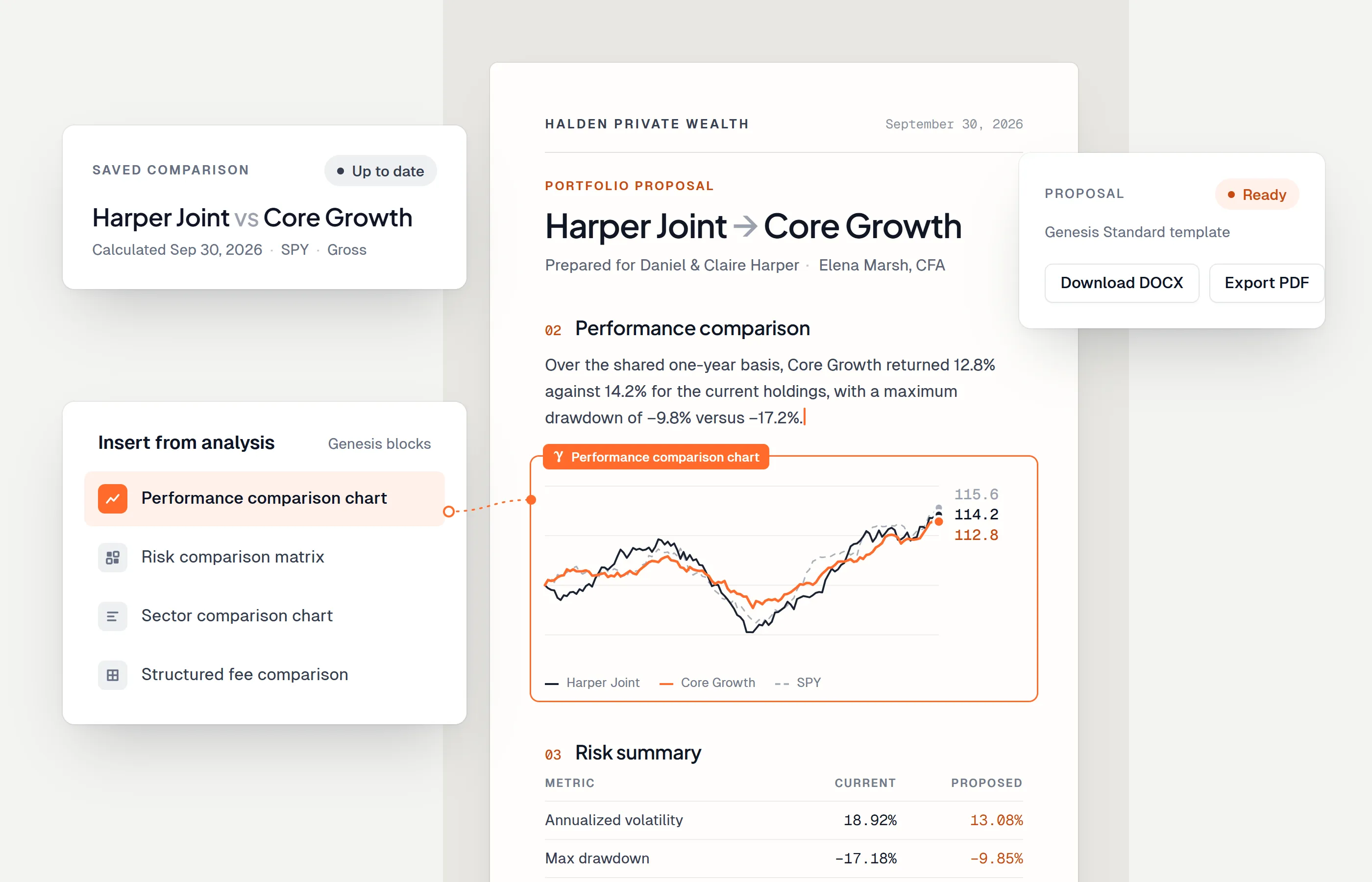
Genesis Risk Monitor is designed around this connected workflow, combining portfolio risk analytics, model portfolio comparison, and fully editable proposal creation. Advisors can move from a prospect portfolio to a customizable proposal and export the final document as PDF or DOCX.
The technology supports the workflow.
The advisor still determines what the analysis means and how it should be communicated.
Frequently Asked Questions
What is a prospect-to-proposal workflow for financial advisors?
A prospect-to-proposal workflow is the process of taking a prospective client’s existing investment portfolio, analyzing its structure and risk, comparing it with a potential alternative or model portfolio, and turning the relevant findings into a client-facing investment proposal.
What should a financial advisor analyze before creating a proposal?
Advisors may review asset allocation, position and sector concentration, diversification, historical volatility, drawdowns, downside risk, correlation, factor exposure, and relevant stress scenarios. The appropriate analysis depends on the portfolio and the purpose of the proposal.
How should advisors compare a current portfolio with a proposed model?
Both portfolios should be evaluated using consistent data, time periods, benchmarks, and analytical methodologies. The comparison should show meaningful differences and trade-offs rather than only metrics that favor the proposed portfolio.
What should a financial advisor client proposal include?
A proposal may include an overview of the current portfolio, key analytical findings, current-versus-proposed comparisons, risk and allocation information, relevant trade-offs, and the advisor’s supporting commentary.
Can financial advisor proposal generation software automate the entire workflow?
Software can automate many repetitive tasks, including portfolio imports, calculations, charts, comparisons, and document generation. Advisor judgment remains important for selecting the appropriate comparison, interpreting the findings, and determining what should appear in the final proposal.
Why are editable investment proposals useful?
Editable proposals allow advisors to combine automated portfolio data with prospect-specific commentary and document customization. This can provide more flexibility than a fixed report while avoiding the inefficiency of building every proposal manually.
Final Thoughts
The journey from a prospect portfolio to a client proposal should be one connected analytical process.
First understand what the prospect owns.
Then identify the portfolio characteristics that matter.
Compare the current position with an appropriate alternative using consistent analysis.
Finally, turn those findings into a clear and customizable proposal.
For financial advisors and RIAs, the best workflow is not the one that generates the most charts or the longest report.
It is the one that creates the clearest connection between the portfolio being analyzed, the differences being identified, and the conversation the advisor needs to have.
Build a More Connected Prospect-to-Proposal Workflow
Genesis Risk Monitor helps financial advisors and RIAs connect prospect portfolio analysis, portfolio risk analytics, model portfolio comparison, and fully editable proposal creation in one workflow.
Try Genesis Risk Monitor for free
Further Reading:
- How to Analyze a Prospect’s Portfolio Before the First Proposal
- Why Editable Investment Proposals Matter for Financial Advisors
- 10 Portfolio Risk Metrics Every Financial Advisor Should Understand
- Portfolio Risk Analytics for Financial Advisors: The Complete Guide
- The Modern Financial Analyst: How an Automated Proposal Generator Transforms Client Acquisition
Disclaimer: The content of this article is for informational and educational purposes only and does not constitute financial advice, investment recommendations, or an endorsement of any specific strategy, security, or platform. Trading and investing involve substantial risk of loss. Platform pricing and feature sets are subject to change — verify current details directly with each provider before making purchasing decisions. Please consult a qualified financial advisor before making any investment decisions.