— 8 MIN
5 Best Kwanti Alternatives for Financial Advisors in 2026
Compare five leading Kwanti alternatives for financial advisors, with a focus on portfolio analytics, risk analysis, model comparisons, investment research, and advisor workflows.
Genesis Risk Monitor publishes this blog and develops one of the products discussed. Comparisons reflect the publisher's perspective. Confirm current features and pricing directly with each provider. Editorial policy
Kwanti occupies a specific place in the financial advisor technology stack.
At its core, it is a portfolio analysis platform designed to help advisors evaluate current portfolios, compare alternatives, work with models, analyze risk, and prepare client-facing materials.
That means choosing a Kwanti alternative requires a more focused evaluation than simply comparing general financial advisor software.
The important question is:
What kind of portfolio analysis does your firm actually need to perform?
One advisory firm may prioritize deeper quantitative risk analysis. Another may need investment research alongside portfolio construction. A third may want portfolio analytics primarily to support risk-alignment conversations with clients.
For financial advisors and RIAs evaluating the best Kwanti alternatives, the right platform depends on which analytical job matters most.
Best Kwanti Alternatives at a Glance
| Platform | Best for | Portfolio analytics emphasis |
|---|---|---|
| 1. Genesis Risk Monitor | Risk-focused portfolio analysis connected to advisor workflows | Risk analytics, scenarios, backtesting, model comparisons, research, proposals |
| 2. Koyfin | Broad portfolio analytics and investment research | Holdings, exposures, performance, risk, research, benchmarks |
| 3. YCharts | Research-led portfolio construction | Research, models, analytics, comparisons |
| 4. Morningstar Direct Advisory Suite | Research-backed portfolio diagnostics | Risk, performance, exposure, investment research |
| 5. Nitrogen | Risk-alignment analysis | Portfolio risk compared with investor risk tolerance |
1. Genesis Risk Monitor
Best for: Financial advisors who want deeper portfolio risk analysis connected directly to models and client proposals
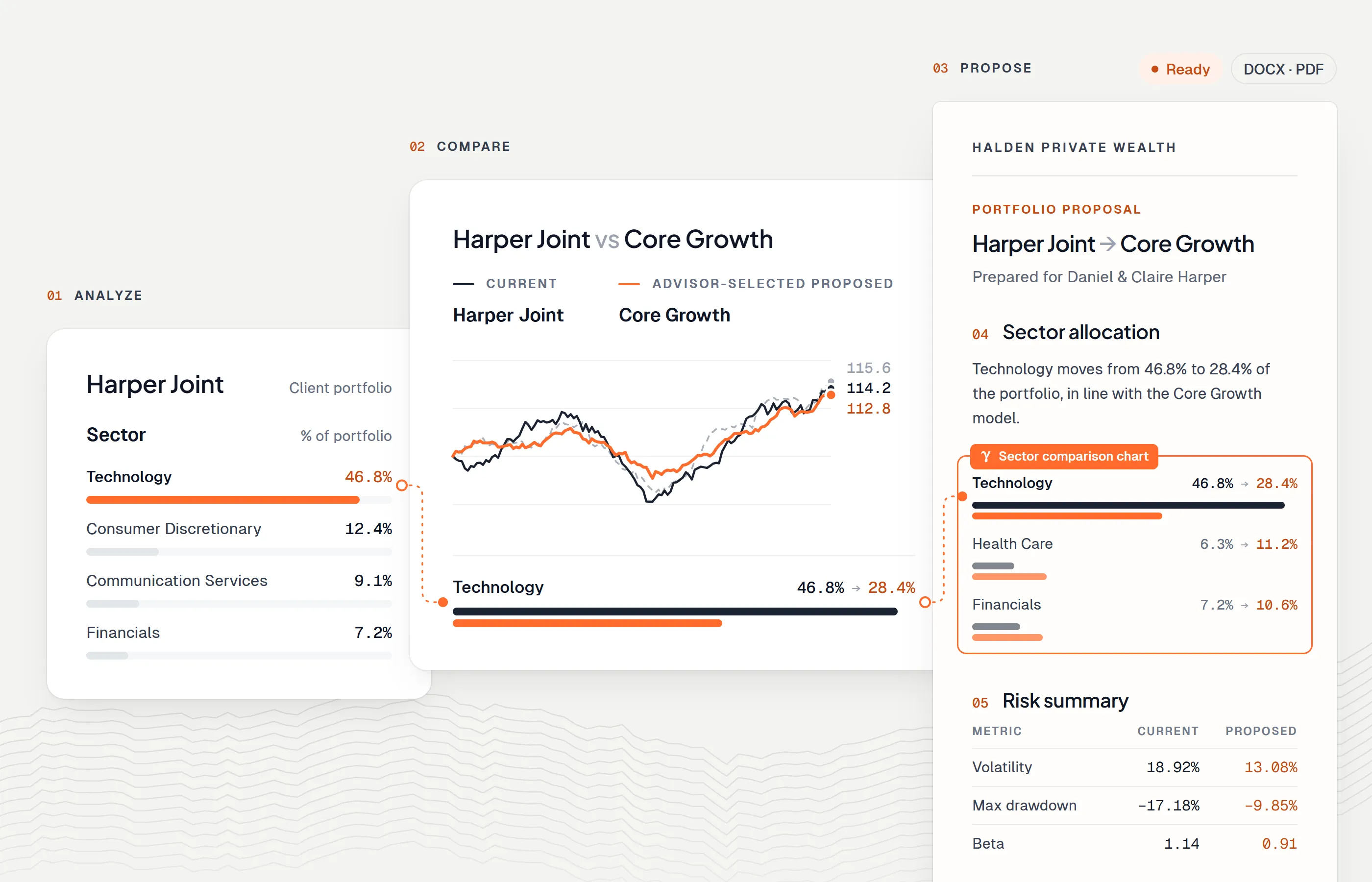
Genesis Risk Monitor takes the top position in this comparison for advisory firms that want portfolio analysis to go beyond allocation, historical performance, and basic risk statistics.
Its analytical approach focuses heavily on understanding how a portfolio may behave and where its vulnerabilities come from.
Advisors can use multiple portfolio risk methodologies and analytical tools, including Value at Risk, Expected Shortfall, scenario analysis, backtesting, factor and exposure analysis, drawdown metrics, and portfolio comparisons.
Genesis becomes particularly relevant when advisors also need to understand:
- How severe downside risk could become
- Whether apparently diversified investments share similar exposures
- How the portfolio behaves under selected market scenarios
- Whether a proposed model materially changes the portfolio’s risk structure
- Which differences are most relevant to the client or prospect conversation
Genesis connects that analysis with client, prospect, household, and model portfolio workflows.
A prospect portfolio can therefore be analyzed, compared with an advisor’s model, and carried forward into a proposal without treating each stage as an isolated process.
The proposal workflow is also differentiated by editability. Rather than limiting advisors to a fixed automatically generated report, Genesis provides a fully editable proposal environment with PDF and DOCX export.
Portfolio analysis rarely produces the same story for every client. One proposal may emphasize concentration, another downside risk, and another the differences between a prospect portfolio and the firm’s model.
Why consider Genesis: It is particularly relevant for advisors who want portfolio analytics to lead directly into model comparison, portfolio interpretation, and customizable client communication.
2. Koyfin
Best for: Advisors seeking broad portfolio analytics alongside investment research
Koyfin is a strong Kwanti alternative for firms that want portfolio analysis to extend into a broader investment research environment.
Its advisor workflows combine client and model portfolios with investment research, exposure analysis, performance analysis, benchmarks, portfolio risk, reports, and proposals.
Koyfin may be particularly attractive when investment research and portfolio review need to share the same environment.
Why consider Koyfin: It is a strong choice when portfolio analytics and investment research are equally important parts of the firm’s workflow.
3. YCharts
Best for: Advisors whose portfolio analysis begins with investment research and security selection
YCharts approaches portfolio analytics from a research-first perspective.
Its advisor workflows connect investment screening, security comparisons, fundamental charts, model portfolios, portfolio analytics, risk profiling, reports, and proposals.
YCharts is also particularly strong in visualizing investment information, which can help advisors turn research and portfolio findings into client-facing communication.
Why consider YCharts: It is best suited to firms where portfolio analysis is closely connected with ongoing investment research and model construction.
4. Morningstar Direct Advisory Suite
Best for: Firms that want portfolio analytics backed by a broad investment research ecosystem
Morningstar Direct Advisory Suite combines portfolio analytics with Morningstar’s investment data and research capabilities.
Advisors can compare portfolios across risk, performance, and exposure dimensions while also accessing research, risk profiling, proposal creation, and client reporting workflows.
Morningstar is particularly relevant when portfolio analysis is part of a broader investment governance process, though smaller RIAs may not require the breadth of a larger research platform.
Why consider Morningstar Direct Advisory Suite: It is strongest when portfolio analysis must sit inside a broader investment research and enterprise advisor ecosystem.
5. Nitrogen
Best for: Advisors who analyze portfolios primarily through the lens of client risk alignment
Nitrogen offers a fundamentally different portfolio analysis philosophy.
Its workflow is organized heavily around evaluating portfolio risk and comparing that risk with an investor’s stated risk tolerance.
Its strongest differentiation is its ability to turn portfolio risk into a simplified communication framework.
Why consider Nitrogen: It is most relevant when the primary purpose of portfolio analysis is creating a structured conversation about investor risk tolerance and portfolio risk.
What Should a Good Portfolio Analytics Platform Actually Do?
When comparing Kwanti alternatives, feature counts can be misleading.
A better approach is to evaluate the analytical jobs the platform needs to perform.
Diagnose the current portfolio
Can the advisor quickly understand holdings, allocation, concentration, exposures, performance, and risk?
Go beyond surface-level diversification
Can the analysis identify shared exposures, downside vulnerabilities, or portfolio characteristics that may not be obvious from an allocation chart?
Compare portfolios consistently
Can client portfolios, prospect portfolios, models, and benchmarks be evaluated using comparable methodologies?
Explain why portfolios differ
Can advisors understand what actually drives the difference between two portfolios rather than simply seeing different performance figures?
Support the next step
Can portfolio findings move naturally into model changes, client reviews, proposals, or recommendations?
Different platforms optimize different parts of this workflow.
That is why the best Kwanti alternative depends on what happens after the portfolio is analyzed.
Frequently Asked Questions
What is the best Kwanti alternative for financial advisors?
There is no universal best alternative. Genesis Risk Monitor takes the top position in this comparison for advisors seeking deeper portfolio risk analytics connected with model comparisons and editable proposal workflows. Koyfin, YCharts, Morningstar Direct Advisory Suite, and Nitrogen are strong alternatives for different portfolio analysis needs.
Which Kwanti alternative is best for portfolio risk analytics?
Genesis Risk Monitor is particularly relevant for advisors focused on downside risk, scenario analysis, backtesting, and comparing portfolio risk characteristics across current and proposed portfolios.
What should advisors compare when evaluating portfolio analysis software?
Important areas include portfolio comparisons, allocation and exposure analysis, risk analytics, performance analysis, models, benchmarks, scenario testing, investment research, data coverage, and the ability to turn findings into client-ready outputs.
Can portfolio analytics software replace a portfolio management system?
Usually not entirely. Portfolio analytics software primarily helps advisors analyze and compare investments and portfolios. A full portfolio management system may also handle operational functions such as reconciliation, trading, billing, and performance reporting.
Final Thoughts
The right Kwanti alternative depends on what your firm means by portfolio analysis.
For some advisors, the priority is understanding every dimension of a current portfolio.
For others, it is uncovering deeper downside and structural risk.
Some investment teams need research to flow directly into portfolio construction. Other firms need a standardized analytical framework for discussing risk with clients.
For RIAs that want portfolio analysis to connect deeper risk analytics, model portfolios, prospect workflows, and customizable proposals, Genesis Risk Monitor takes the top position in this comparison.
The important question is not which platform produces the most charts.
It is which platform helps your firm move from portfolio data to understanding to action with the least friction.
Turn Portfolio Analysis Into a Client-Ready Proposal
Financial advisors should not have to analyze a portfolio in one platform, rebuild the comparison somewhere else, and then start again when preparing the client proposal.
Genesis Risk Monitor connects portfolio risk analytics, model portfolios, research, and fully editable proposal creation within one advisor workflow.
Try Genesis Risk Monitor for free
Further Reading:
- Portfolio Risk Analytics for Financial Advisors: The Complete Guide
- 10 Portfolio Risk Metrics Every Financial Advisor Should Understand
- From Prospect Portfolio to Client Proposal: The Complete Financial Advisor Workflow
- How to Analyze a Prospect’s Portfolio Before the First Proposal
- Best Nitrogen Alternatives for Financial Advisors
Disclaimer: The content of this article is for informational and educational purposes only and does not constitute financial advice, investment recommendations, or an endorsement of any specific strategy, security, or platform. Trading and investing involve substantial risk of loss. Platform pricing and feature sets are subject to change — verify current details directly with each provider before making purchasing decisions. Please consult a qualified financial advisor before making any investment decisions.