— 7 MIN
5 Best Nitrogen Alternatives for Financial Advisors in 2026
Compare the best Nitrogen and Riskalyze alternatives for financial advisors and RIAs, with a focus on portfolio risk analytics, risk profiling, client communication, and proposals.
Genesis Risk Monitor publishes this blog and develops one of the products discussed. Comparisons reflect the publisher's perspective. Confirm current features and pricing directly with each provider. Editorial policy
For many financial advisors, portfolio risk software serves two different purposes.
The first is analytical: understanding how much risk a portfolio contains, where that risk comes from, and how the portfolio may behave under different market conditions.
The second is communicative: translating that analysis into something a client can actually understand.
Nitrogen, formerly Riskalyze, has built its advisor workflow around this connection. Its Risk Number and 95% Historical Range give advisors a simplified framework for discussing the relationship between investor risk tolerance and portfolio risk, alongside stress testing, portfolio analytics, and proposals.
But not every advisory firm wants to communicate risk through the same framework.
Some RIAs need deeper quantitative portfolio analytics. Others prioritize enterprise risk supervision, portfolio diagnostics, customizable proposals, or highly visual client presentations.
For advisors researching Nitrogen alternatives or the legacy search term Riskalyze alternatives, the key question is not simply which platform has a risk score.
It is: How does your firm want to understand risk, and how does it want clients to understand it?
Best Nitrogen Alternatives at a Glance
| Platform | Best for | Primary approach to risk |
|---|---|---|
| 1. Genesis Risk Monitor | Quantitative risk analysis and editable proposals | Multiple risk metrics and portfolio diagnostics |
| 2. Morningstar Direct Advisory Suite | Risk profiling with research and compliance workflows | Client risk profile aligned with portfolio risk |
| 3. Kwanti | Portfolio analysis and advisor-led risk conversations | Portfolio diagnostics and historical stress testing |
| 4. StratiFi | Firmwide risk, supervision, and proposal workflows | Multifactor risk scoring and monitoring |
| 5. CapIntel | Visual risk communication and presentations | Client-friendly analytics and scenario storytelling |
1. Genesis Risk Monitor
Best for: Advisors who want to investigate portfolio risk beyond a single risk score
Genesis Risk Monitor takes a different approach to the risk conversation.
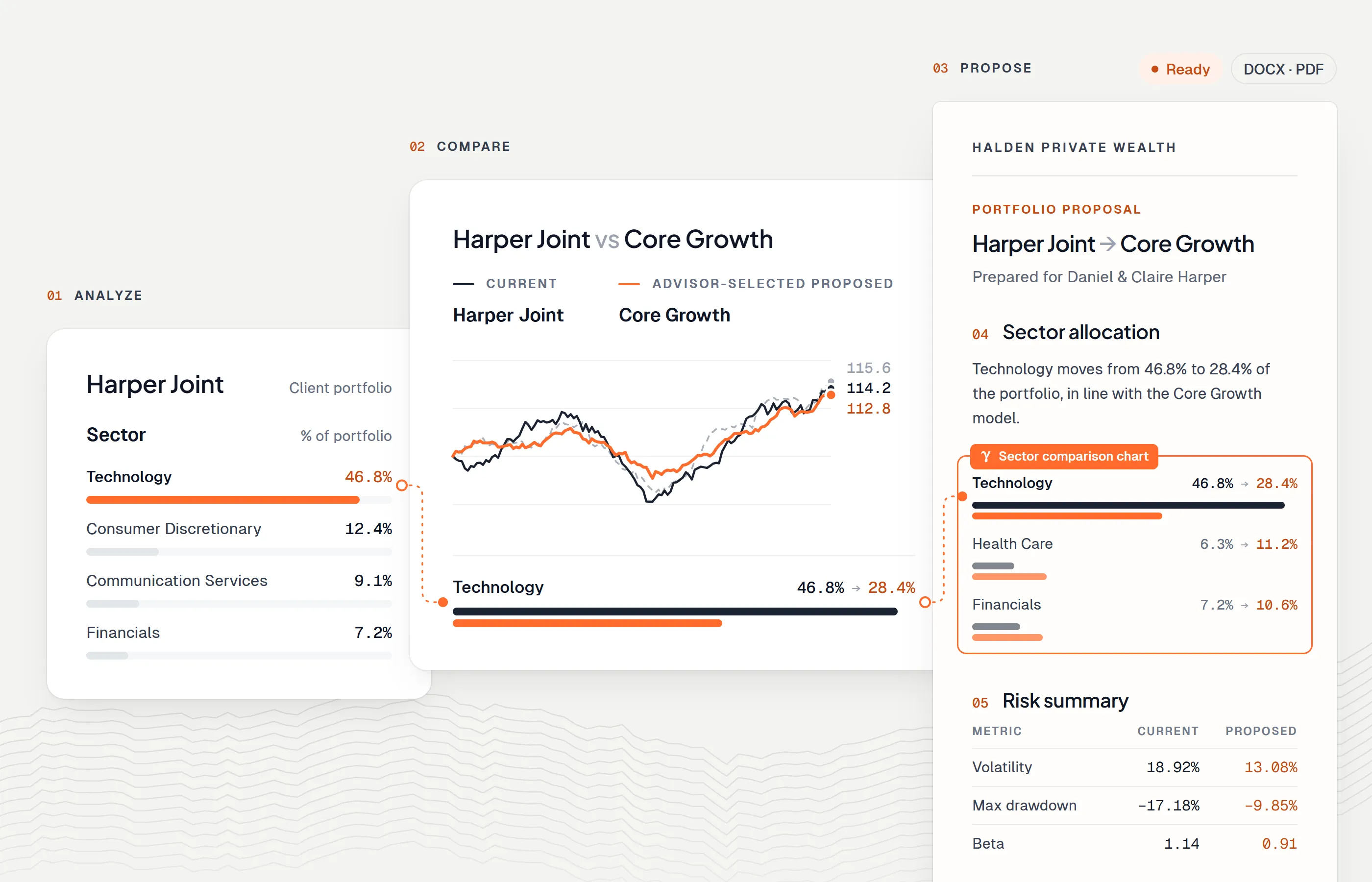
Instead of making one proprietary score the center of the workflow, the platform gives advisors access to multiple analytical perspectives, including Value at Risk, Expected Shortfall, backtesting, scenario analysis, and other portfolio risk diagnostics. Its advisor platform also connects those analytics with proposal creation.
This approach is particularly relevant when the advisor’s question is not simply, “Does this portfolio match the client’s risk tolerance?”
The advisor may also want to understand:
- Where downside risk is concentrated
- How severe tail losses may become
- Whether apparently diversified positions share similar risk drivers
- How a current portfolio compares with an advisor’s model
- What happens under selected market scenarios
Genesis then allows those findings to move into a proposal workflow rather than remaining isolated inside an analytics dashboard.
That makes it a strong Nitrogen alternative for firms that prefer to build their client risk narrative from several portfolio metrics rather than organize the entire conversation around one number.
Why consider Genesis: It is particularly relevant for advisors who want deeper quantitative portfolio analysis and greater control over how those findings are presented in the final proposal.
2. Morningstar Direct Advisory Suite
Best for: Advisory firms that want risk profiling connected with investment research, proposals, and compliance
Morningstar Direct Advisory Suite approaches risk from the relationship between the investor and the portfolio.
Its workflow includes a Risk Profiler, Portfolio Risk Score, and Risk Comfort Range designed to help advisors compare a client’s risk profile with the risk of current and proposed portfolios. The broader platform connects this with investment research, portfolio analytics, proposals, reports, and compliance workflows.
Why consider Morningstar: It is a strong option when risk communication needs to sit inside a broader research, proposal, and governance environment.
3. Kwanti
Best for: Advisors who want portfolio analysis to drive the risk conversation
Kwanti is one of the most direct advisor-oriented alternatives to Nitrogen.
Its workflow emphasizes portfolio analysis across allocation, drawdowns, and risk exposure, alongside stress testing, model management, portfolio comparisons, risk profiling, and branded proposals.
Why consider Kwanti: It is particularly well suited to advisors who want the client risk discussion to emerge from a broader portfolio review rather than begin with a single portfolio risk score.
4. StratiFi
Best for: Growing RIAs that want risk analytics connected with supervision and firmwide processes
StratiFi combines portfolio risk assessment with proposal generation and broader firm-level workflows.
Its PRISM methodology evaluates several dimensions of portfolio risk and translates the analysis into a simplified score. The platform also supports portfolio comparisons and proposal workflows, while its broader positioning extends into compliance and supervisory use cases.
Why consider StratiFi: It is worth evaluating when portfolio risk needs to connect with firmwide standardization, proposal oversight, and compliance operations.
5. CapIntel
Best for: Wealth firms that prioritize how risk analysis is presented to clients
CapIntel approaches risk analytics primarily as a communication problem.
Its analytics capabilities can incorporate risk profiles, portfolio allocation, risk metrics, tax implications, and historical scenarios. Those insights can then move directly into branded, client-facing presentations.
Why consider CapIntel: It is strongest when client storytelling and presentation quality are the primary priorities surrounding the risk conversation.
How Should Advisors Choose a Nitrogen Alternative?
Start with the role risk plays in your advisory process.
Choose Genesis Risk Monitor when you want risk to be investigated through multiple quantitative measures.
Choose Morningstar Direct Advisory Suite when risk profiling needs to connect with research, compliance, and standardized reports.
Choose Kwanti when you want risk conversations to emerge from portfolio analysis.
Choose StratiFi when risk processes must scale across advisors, operations, and compliance.
Choose CapIntel when the central challenge is translating analysis into clearer client presentations.
The most useful Nitrogen alternative is therefore not necessarily the platform with the most sophisticated risk score.
It is the platform whose risk philosophy matches your advisory philosophy.
Frequently Asked Questions
What is the best Nitrogen alternative for financial advisors?
There is no universal best alternative. Genesis Risk Monitor is particularly relevant for deeper quantitative risk analytics, while Morningstar combines risk profiling with broader research and reporting. Kwanti emphasizes portfolio analysis, StratiFi connects risk with firmwide workflows, and CapIntel focuses heavily on client communication.
Is Nitrogen the same company as Riskalyze?
Yes. Nitrogen is the current brand of the company previously known as Riskalyze. Its advisor platform continues to use the Risk Number as a central framework for connecting investor risk tolerance with portfolio risk.
Which Nitrogen alternative is best for advanced portfolio risk analytics?
Genesis Risk Monitor is the most quantitatively oriented option in this comparison, particularly for advisors interested in downside and scenario-based portfolio analysis rather than relying primarily on a single risk score.
What should financial advisors look for in risk analytics software?
Advisors should evaluate how the platform measures portfolio risk, whether it distinguishes investor risk tolerance from portfolio analytics, the quality of scenario and stress analysis, model comparison capabilities, and how easily the resulting insights can be communicated to clients.
Final Thoughts
Nitrogen’s success demonstrates an important principle: sophisticated analysis only creates value when advisors can explain it.
But there is more than one way to build that bridge.
Some firms need a simple shared language around risk. Others want deeper quantitative diagnostics. Some need risk integrated with compliance and supervision. Others primarily need better client presentations.
When comparing the best Nitrogen alternatives for financial advisors, start with the conversation you want your risk analysis to create.
Then choose the analytical framework that best supports it.
Build a More Flexible Risk Analytics Workflow
Financial advisors should not have to choose between sophisticated portfolio risk analysis and clear client communication.
Genesis Risk Monitor connects quantitative risk analytics, model portfolio comparison, and fully editable proposal creation in one advisor workflow.
Try Genesis Risk Monitor for free
Further Reading:
- Portfolio Risk Analytics for Financial Advisors: The Complete Guide
- 10 Portfolio Risk Metrics Every Financial Advisor Should Understand
- How to Measure Investment Risk: VaR, CVaR, and Factor Exposure Explained
- What Is Scenario Analysis? A Complete Guide for Finance and Investing
- How to Stress Test Your Portfolio
Disclaimer: The content of this article is for informational and educational purposes only and does not constitute financial advice, investment recommendations, or an endorsement of any specific strategy, security, or platform. Trading and investing involve substantial risk of loss. Platform pricing and feature sets are subject to change — verify current details directly with each provider before making purchasing decisions. Please consult a qualified financial advisor before making any investment decisions.