— 10 MIN
How to Compare Investment Funds Beyond Performance: An Advisor Due-Diligence Framework
Learn how financial advisors can compare investment funds across mandate, benchmark, holdings, overlap, concentration, factors, downside risk, costs, and portfolio fit.
Fund comparisons often begin with a return table.
One fund returned more over one, three, or five years. Another has a higher rating. A third charges a lower fee.
Those figures are useful, but they do not answer the most important question:
What role does each fund play, what risks does it take, and how would it change the client’s total portfolio?
Two funds can produce similar returns through very different exposures. They can carry different concentration, duration, style, liquidity, or downside risk. They can also look diversified individually while creating substantial overlap when held together.
A professional fund-comparison process should therefore move beyond headline performance.
1. Confirm That the Funds Are Comparable
Before reviewing returns, determine whether the funds are designed to do the same job.
Compare:
- Investment objective
- Asset class
- Geographic scope
- Market-cap focus
- Style
- Active or passive approach
- Income or total-return objective
- Currency policy
- Use of derivatives
- Concentration limits
- Benchmark
A global equity fund should not be judged against a domestic value fund simply because both appear in an equity allocation.
The comparison should begin with mandate, not ranking.
2. Evaluate the Benchmark
A benchmark provides context for both performance and risk.
Ask:
- Is the benchmark consistent with the fund’s stated mandate?
- Has the benchmark changed?
- Is the fund structurally different from the index?
- Is the fund’s cash position material?
- Does the fund take off-benchmark sector or country exposure?
- Is a broad index hiding a more appropriate peer benchmark?
A fund can outperform an unsuitable benchmark while still performing poorly relative to the risks it actually takes.
For advisors, benchmark selection also affects client communication. A comparison should explain why the reference point is relevant.
3. Look Through the Holdings
Fund names and category labels can hide what investors actually own.
Review:
- Largest positions
- Number of holdings
- Sector weights
- Country exposure
- Market capitalization
- Credit quality for bond funds
- Maturity and duration for fixed income
- Cash exposure
- Derivative exposure where disclosed
The objective is not to criticize concentration automatically. It is to understand whether the fund’s holdings are consistent with its stated role.
A concentrated active fund may be intentional. A core diversified fund with a few dominant positions may require a different conversation.
4. Measure Fund and Portfolio Overlap
Two funds can have different tickers and marketing descriptions while owning many of the same securities.
Overlap can appear through:
- Identical underlying holdings
- Similar sector weights
- Shared geographic exposure
- Common market-cap bias
- Similar duration or credit exposure
- The same systematic factors
The advisor should consider overlap at two levels.
Direct Holdings Overlap
What percentage of the funds is invested in the same securities?
Economic Exposure Overlap
Do the funds behave similarly because they share sector, factor, duration, currency, or macroeconomic exposure?
Direct overlap is easier to see. Economic overlap is often more important during market stress.
For a deeper discussion, read The Illusion of Diversification: How to Find Hidden Concentration Risk.
5. Compare Concentration
A fund with 100 holdings is not necessarily more diversified than a fund with 40.
Review:
- Weight of the largest holding
- Weight of the top five or ten holdings
- Sector concentration
- Country concentration
- Issuer concentration
- Credit concentration
- Factor concentration
Concentration should be interpreted relative to the mandate.
An index fund may inherit concentration from the index. An active fund may intentionally express a small number of views. The question is whether the concentration is understood and appropriate for the fund’s role in the portfolio.
6. Analyze Style and Factor Exposure
A fund’s label may not fully describe its behavior.
Factor analysis can help identify exposure to characteristics such as:
- Market beta
- Size
- Value
- Growth
- Momentum
- Quality
- Low volatility
Two funds marketed as different strategies can still share the same underlying factor tilts.
This matters when an advisor combines funds. A portfolio containing several products may still depend heavily on one market regime.
Factor exposure should not be treated as a permanent identity. It can change as holdings and market conditions evolve.
7. Compare Downside, Not Only Average Return
Average returns can obscure the path investors experienced.
Consider:
- Volatility
- Maximum drawdown
- Downside deviation
- Recovery time
- Worst rolling periods
- Value at Risk, where appropriate
- Expected Shortfall, where appropriate
- Performance during relevant stress periods
A fund with a higher long-term return may also have experienced materially deeper losses.
For client conversations, the drawdown path may be more understandable than a single volatility statistic.
The Portfolio Risk Metrics for Financial Advisors guide explains how the main measures differ.
8. Use Rolling Periods
Point-to-point returns can depend heavily on the selected start and end date.
Rolling analysis can show:
- Consistency
- Range of outcomes
- Frequency of outperformance
- Dependence on one market period
- Behavior through different regimes
Useful windows may include rolling one-year, three-year, or five-year periods, depending on the fund’s history and mandate.
The objective is not to find the period that makes one fund look best. It is to test whether the conclusion remains stable across reasonable periods.
9. Review Costs and Trading Characteristics
Risk and return should be interpreted after costs.
Depending on the fund type, review:
- Expense ratio
- Transaction costs
- Sales loads
- Bid-ask spread
- Premium or discount to net asset value
- Turnover
- Tax distributions
- Securities-lending practices
- Liquidity
- Assets under management
- Tracking difference for passive funds
Lower cost is valuable, but it is not the only consideration. A low-cost fund can still be unsuitable for the intended portfolio role.
Advisors should distinguish between the published fee and the total cost of holding and trading the fund.
10. Evaluate the Fund Inside the Total Portfolio
A fund should not be selected in isolation.
Ask what changes when it is added:
- Does total concentration increase or decrease?
- Does it duplicate an existing holding?
- Does it improve geographic diversification?
- Does it create an unintended factor tilt?
- Does portfolio volatility change?
- Does downside exposure change?
- Does it move the portfolio closer to or farther from the target allocation?
- Does it make the client explanation clearer or more complex?
A fund that looks attractive on its own may add little value to a portfolio that already holds similar exposures.
This is where fund analysis connects with portfolio comparison.
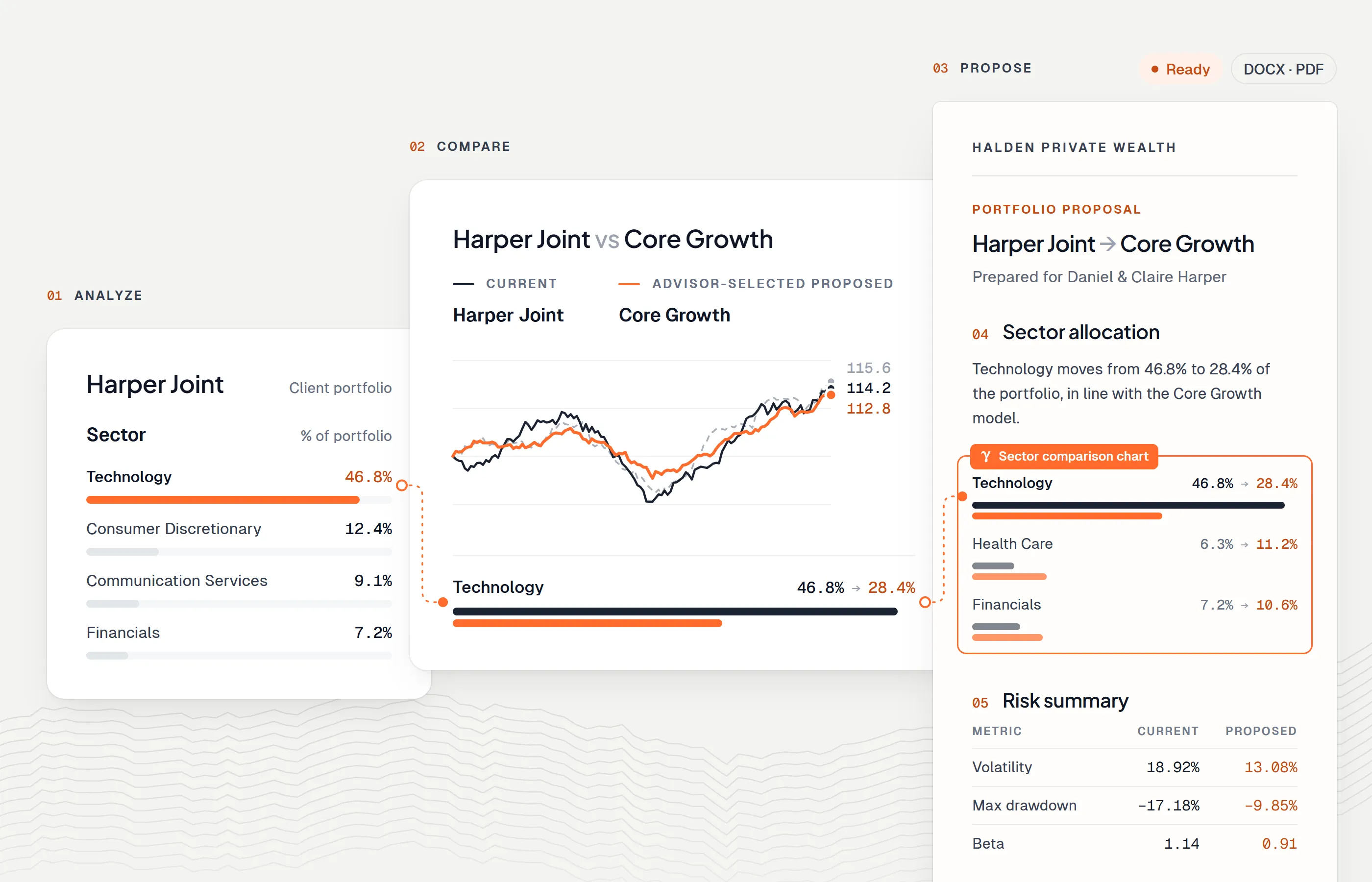
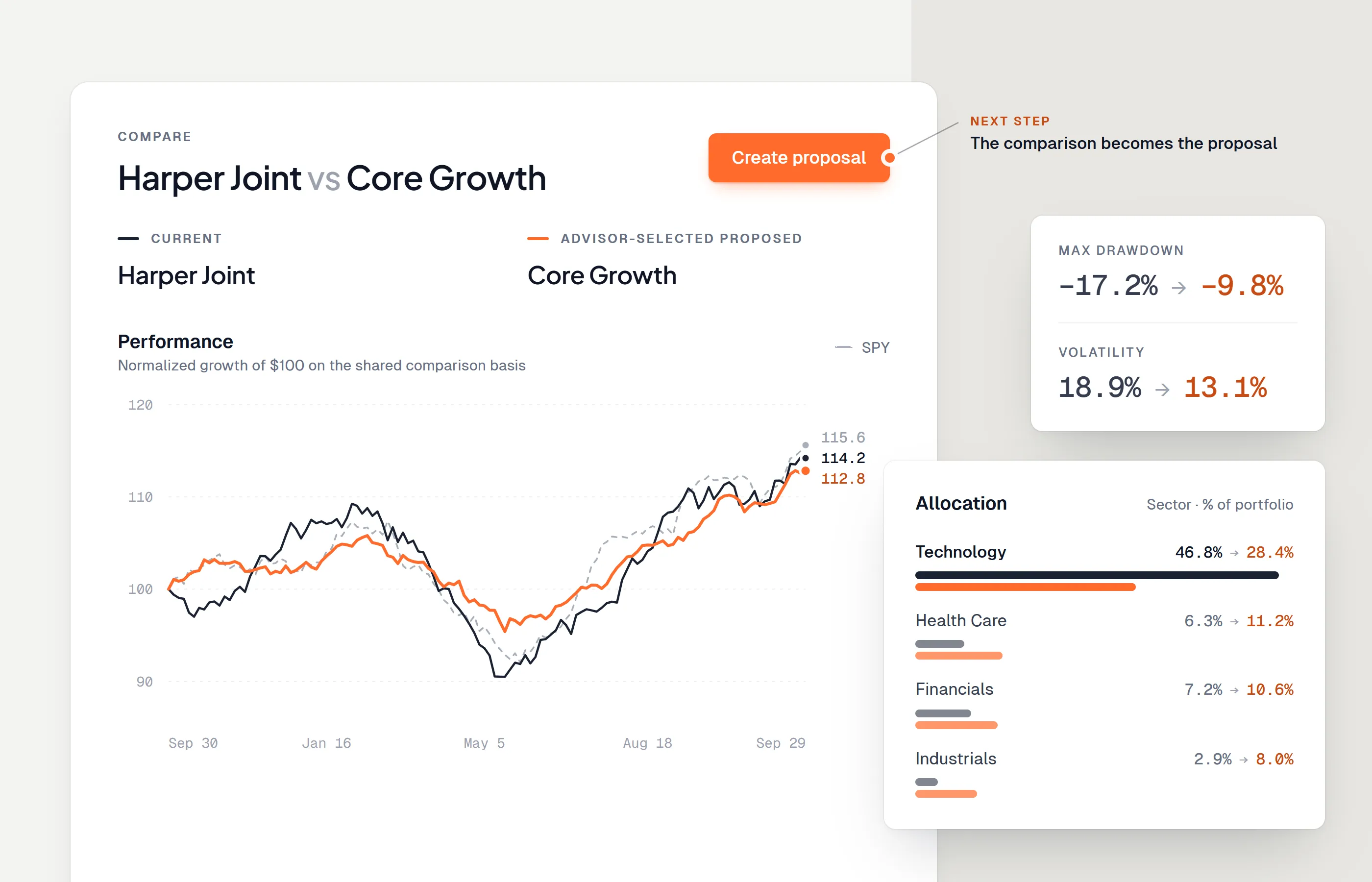
Genesis Risk Monitor’s Portfolio Comparison workflow is designed to compare portfolios and advisor-created models consistently across allocation, exposure, performance, and selected risk measures. Fund-level due diligence remains one input into that broader decision.
A Practical Fund-Comparison Scorecard
A useful scorecard can include:
| Dimension | Questions |
|---|---|
| Mandate | Are the funds designed to solve the same problem? |
| Benchmark | Is the reference index appropriate? |
| Holdings | What does each fund actually own? |
| Overlap | Which securities and economic exposures are duplicated? |
| Concentration | Where are the largest dependencies? |
| Factor exposure | Which systematic drivers dominate? |
| Downside | How did each fund behave during losses? |
| Consistency | Are results dependent on one period? |
| Costs | What is the total cost of ownership? |
| Portfolio fit | How does the fund change the client’s full portfolio? |
The scorecard should not produce an automatic recommendation. It should organize the evidence used in the advisor’s analysis.
Common Fund-Comparison Mistakes
Avoid:
- Selecting the fund with the highest recent return
- Comparing funds with different mandates
- Using an irrelevant benchmark
- Ignoring holdings overlap
- Assuming a larger number of securities means better diversification
- Comparing metrics calculated over different periods
- Ignoring fees, liquidity, and tax considerations
- Evaluating the fund without the rest of the client’s portfolio
- Treating historical results as a forecast
A credible comparison makes the limitations visible.
Final Thoughts
Fund comparison is not a race between return percentages.
The advisor should understand what each fund is designed to do, what it owns, which risks drive its behavior, and how it changes the client’s existing portfolio.
Performance belongs in the analysis. It should not be the entire analysis.
Disclaimer: This article is for informational and educational purposes only and does not constitute investment advice or a recommendation of any fund, security, or strategy. Fund data, holdings, fees, and characteristics can change. Review current official materials before making decisions.
Frequently asked questions
What should advisors compare when evaluating investment funds?
Advisors can compare mandate, benchmark, holdings, concentration, overlap, style and factor exposure, drawdown, risk-adjusted performance, costs, liquidity, tax characteristics, and the role each fund would play in the client's total portfolio.
Why is past performance not enough when comparing funds?
Past performance does not show whether funds followed the same mandate, took the same risks, held similar securities, or behaved consistently across different market environments.
How can two different funds create portfolio overlap?
Funds with different names or categories can own many of the same securities or share similar sector and factor exposures, causing the combined portfolio to be less diversified than it appears.
Should funds be compared using the same benchmark?
Only when the benchmark is relevant to both funds. A comparison is more credible when each fund's mandate and benchmark are understood before performance or risk metrics are interpreted.