— 9 MIN
Risk Tolerance vs. Risk Capacity: A Practical Guide for Financial Advisors
Learn the difference between risk tolerance and risk capacity, why advisors should assess both, and how to connect client discovery with objective portfolio risk analysis.
Risk discussions often begin with a single question: How much risk is the client willing to take?
That question matters, but it is incomplete.
A client may be emotionally comfortable with market volatility while being financially unable to absorb a large loss. Another client may have substantial financial capacity but become anxious during ordinary market declines. Treating both situations as one risk score can lead to weak portfolio conversations and unclear documentation.
Financial advisors should therefore separate at least two concepts:
- Risk tolerance: how much uncertainty and loss the client is psychologically willing to accept.
- Risk capacity: how much loss the client can financially absorb without compromising important goals or obligations.
The distinction is more than terminology. It changes how an advisor interprets a questionnaire, analyzes an existing portfolio, selects a model for comparison, and explains trade-offs in a proposal.
What Is Investment Risk Tolerance?
Investment risk tolerance describes a person’s willingness to accept uncertainty, fluctuations, and possible losses in pursuit of investment returns.
It is influenced by factors such as:
- Prior investing experience
- Emotional response to market declines
- Confidence in the investment process
- Expectations about return
- Perception of loss
- Familiarity with different asset classes
- Past financial experiences
Risk tolerance is psychological. That means it may not remain stable under pressure.
A client who selects aggressive answers during a calm market may react differently after a meaningful drawdown. For that reason, a questionnaire should be treated as one source of evidence, not as a permanent or complete description of the client.
What Is Risk Capacity?
Risk capacity is the client’s financial ability to experience investment losses without placing essential objectives at unacceptable risk.
It can depend on:
- Time horizon
- Required withdrawals
- Income stability
- Emergency reserves
- Debt and other liabilities
- Dependence on the portfolio
- Goal flexibility
- Concentration in a business or employer stock
- Tax circumstances
- Other assets and sources of income
Risk capacity is not about how the client feels. It is about what the financial plan can withstand.
A 35-year-old investor with stable income, significant savings, and no near-term portfolio withdrawals may have substantial capacity for volatility. A retired client who needs regular distributions from the portfolio may have lower capacity even if they describe themselves as comfortable with risk.
Risk Tolerance and Risk Capacity Can Conflict
The most important cases are often those where the two measures point in different directions.
High Tolerance, Low Capacity
The client is willing to take risk but cannot easily absorb a major loss.
This can occur when a confident investor:
- Has a short time horizon
- Needs portfolio withdrawals soon
- Holds significant debt
- Depends heavily on one account
- Has an inflexible financial goal
The advisor should not treat confidence as proof of financial capacity.
Low Tolerance, High Capacity
The client has the financial resources to withstand volatility but is uncomfortable doing so.
This can occur when a financially secure client:
- Has experienced a previous market loss
- Is unfamiliar with investing
- Focuses heavily on short-term results
- Has a strong preference for stability
- Is likely to abandon the strategy during a decline
A portfolio that is financially sustainable may still be behaviorally unsustainable.
Aligned Tolerance and Capacity
When willingness and capacity are broadly aligned, portfolio discussions may be more straightforward. Even then, the advisor should still test whether the current portfolio’s actual risk characteristics match the client’s understanding.
Where Required Risk Fits
A third concept is sometimes useful: required risk.
Required risk is the level of investment risk assumed to be necessary to pursue a stated goal under the financial plan’s assumptions.
This creates three separate questions:
- How much risk is the client willing to take?
- How much risk can the client afford to take?
- How much risk appears necessary to pursue the goal?
These answers may not match.
For example, a client may have low tolerance and low capacity while expecting a return that would normally require a more aggressive portfolio. The solution is not to force the portfolio to meet the expectation. The advisor may need to revisit the goal, time horizon, contribution rate, spending plan, or return assumption.
What Risk-Profiling Tools Should Measure
Risk-profiling tools can help create a consistent discovery process, but the tool should not reduce every dimension to one opaque score.
A useful process should distinguish among:
- Emotional willingness to accept loss
- Financial ability to absorb loss
- Time horizon
- Liquidity requirements
- Goal importance
- Investment experience
- Reaction to hypothetical drawdowns
- Dependence on the portfolio
- Constraints and preferences
The wording of questions matters. Asking whether a client prefers “higher returns” is not the same as showing the potential loss associated with pursuing them.
Scenario-based questions can often produce better conversations than abstract labels such as conservative, moderate, or aggressive.
Connect Client Discovery With Portfolio Evidence
A risk profile describes the client. Portfolio analytics describe the investments.
Those are separate analytical objects.
An advisor can use portfolio analysis to answer questions such as:
- How concentrated is the current portfolio?
- How large were its historical drawdowns?
- What are its major sector or factor exposures?
- How sensitive has it been to a benchmark?
- How could it behave under selected stress scenarios?
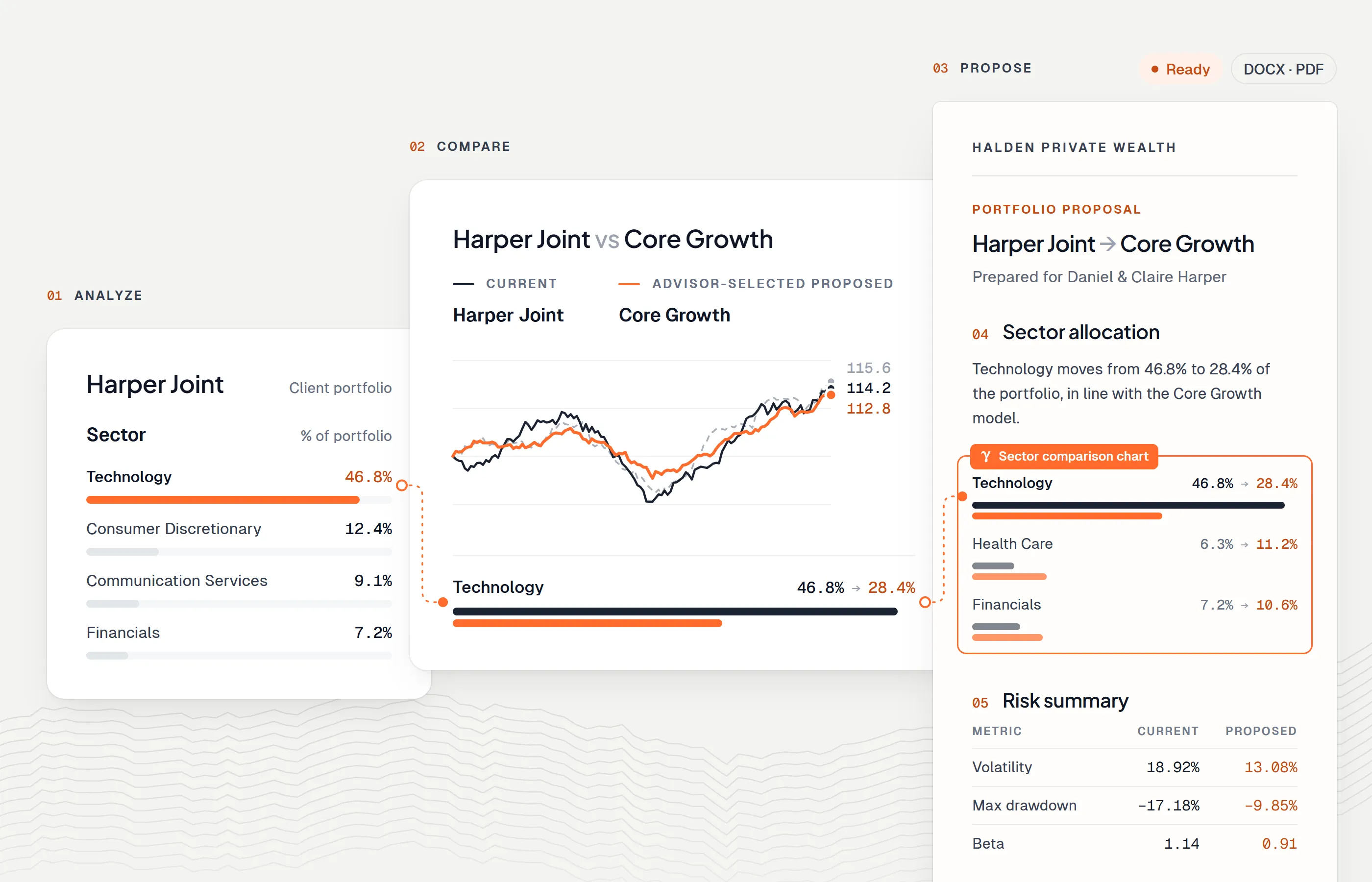
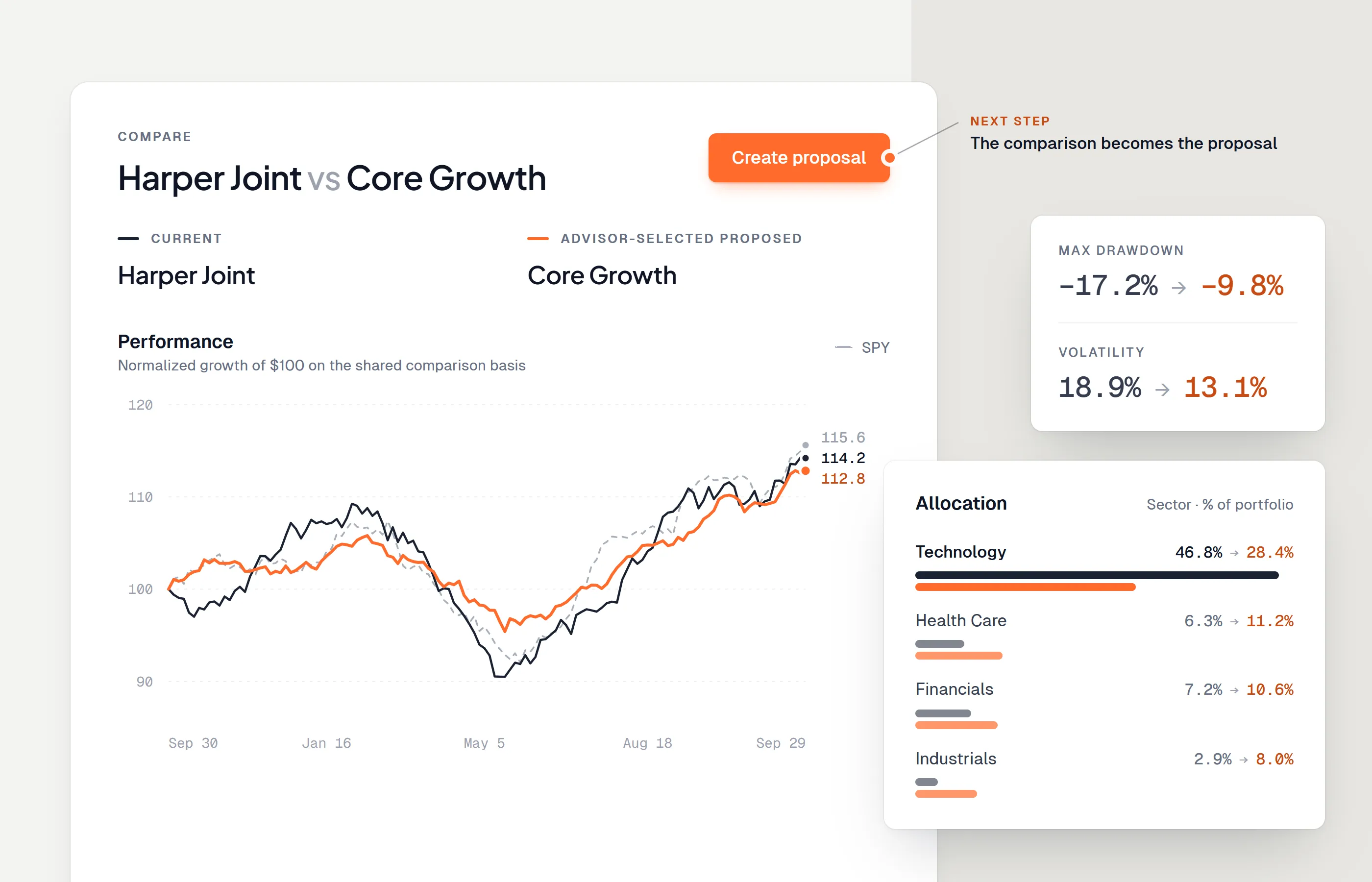
- How does it differ from an advisor-created model?
The objective is not to convert analytics into an automatic suitability decision. It is to compare the risk the client can accept with the risk the portfolio actually contains.
For example:
Client evidence: The client has limited capacity for a prolonged decline because withdrawals begin within two years.
Portfolio evidence: The current portfolio has high equity concentration and a history of significant drawdowns.
Advisor discussion: The portfolio’s loss characteristics may not be consistent with the client’s near-term dependency on the assets.
This structure is more defensible than relying on a generic risk label.
For a practical portfolio-review framework, see How to Analyze a Prospect’s Portfolio Before the First Proposal.
Avoid Turning Risk Scores Into Recommendations
A risk score can organize information, but it should not become an automatic investment recommendation.
Several errors can result:
- Assuming two clients with the same score have the same circumstances
- Ignoring a mismatch between tolerance and capacity
- Treating a questionnaire as permanent
- Mapping a score directly to one model portfolio
- Failing to review the client’s existing holdings
- Presenting modeled risk as a forecast
- Overlooking concentration outside the analyzed account
The advisor remains responsible for understanding the client, interpreting the evidence, applying the firm’s process, and documenting the rationale.
A Practical Advisor Workflow
A repeatable process can follow six steps.
1. Gather Client Information
Document objectives, time horizon, cash-flow needs, liabilities, outside assets, experience, constraints, and preferences.
2. Assess Willingness
Use clear questions and realistic loss scenarios to understand how the client may respond to volatility.
3. Assess Capacity
Evaluate whether the client can absorb losses without undermining essential spending or goals.
4. Analyze the Existing Portfolio
Review allocation, concentration, volatility, drawdown, downside measures, correlation, and scenario sensitivity.
The Portfolio Risk Metrics for Financial Advisors guide explains the role of the main measures.
5. Compare Alternatives Consistently
When comparing the current portfolio with an advisor-created model, use the same periods, benchmarks, assumptions, and methodology.
6. Document the Trade-Offs
Explain where tolerance, capacity, required risk, and portfolio characteristics align or conflict.
How Genesis Risk Monitor Fits Into the Process
Genesis Risk Monitor provides portfolio analytics, model comparison, and proposal-building tools. It can help advisors measure the portfolio side of the discussion and carry selected findings into an editable client document.
The platform does not determine client suitability or select the appropriate investment strategy. The advisor remains responsible for client discovery, model selection, interpretation, compliance review, and the final recommendation.
That distinction is important:
Risk profiling explains the client. Portfolio analytics explain the investments. Professional judgment connects the two.
Final Thoughts
Risk tolerance and risk capacity answer different questions.
Tolerance describes willingness. Capacity describes financial ability. Required risk describes the tension between the client’s goals and the assumptions needed to pursue them.
Advisors can improve the quality of portfolio discussions by keeping these concepts separate, testing them against objective portfolio evidence, and documenting where they align or conflict.
A single risk score may be convenient. A well-supported risk conversation is more useful.
Disclaimer: This article is for informational and educational purposes only. It does not constitute financial, legal, regulatory, or compliance advice. Firms should apply their own procedures and applicable requirements when assessing clients and making recommendations.
Frequently asked questions
Can someone have high risk tolerance but low risk capacity?
Yes. A client may feel comfortable taking risk but have limited financial ability to absorb losses because of a short time horizon, concentrated liabilities, or dependence on portfolio withdrawals.
Does portfolio risk analytics determine client suitability?
No. Portfolio analytics can measure the characteristics of an investment portfolio, but suitability requires client discovery, professional judgment, firm procedures, and any applicable compliance requirements.