— 9 MIN Updated
What Is a Portfolio Risk Analytics Platform? Features and Evaluation Guide
Learn what a portfolio risk analytics platform does, which capabilities matter, and how to evaluate data quality, VaR, Expected Shortfall, factor exposure, stress testing, monitoring, and reporting.
Genesis Risk Monitor publishes this blog and develops one of the products discussed. Comparisons reflect the publisher's perspective. Confirm current features and pricing directly with each provider. Editorial policy
A portfolio risk analytics platform is not simply a dashboard that displays prices and performance. It is a system that turns holdings and market data into a structured explanation of portfolio risk.
The distinction matters. A portfolio can perform well while becoming increasingly concentrated. It can contain many holdings that respond to the same market factor. It can show moderate historical volatility while remaining vulnerable to a specific interest-rate, liquidity, or equity-market shock.
Risk analytics help make those vulnerabilities measurable. This guide explains what a portfolio risk analytics platform should do, how its core capabilities fit together, and what investors, advisors, and portfolio teams should examine before selecting one.
This page focuses on the software category and evaluation criteria. For a ranked commercial comparison aimed specifically at advisory firms, read Best Portfolio Analysis Software for Financial Advisors and RIAs.
What Does a Portfolio Risk Analytics Platform Do?
A risk analytics platform combines four inputs:
- Portfolio holdings — securities, quantities, values, weights, accounts, and portfolio structure.
- Market and reference data — prices, returns, classifications, benchmarks, and other analytical inputs.
- Risk methodologies — statistical and financial models used to calculate exposures and potential losses.
- Workflow and reporting tools — the views, comparisons, alerts, and exports through which users interpret the results.
The output should answer practical questions:
- Where is the portfolio concentrated?
- Which holdings or exposures drive most of its risk?
- How volatile has it been?
- What was its largest historical drawdown?
- How might it behave under a selected historical or hypothetical scenario?
- How severe could modeled downside become?
- How different is it from a benchmark, client portfolio, or model portfolio?
A useful platform should not produce numbers without context. It should make the methodology, time horizon, confidence level, benchmark, and data period visible enough for the user to interpret the result correctly.
Portfolio Tracker vs. Portfolio Risk Analytics Platform
The two categories overlap, but their primary jobs differ.
| Capability | Portfolio tracker | Risk analytics platform |
|---|---|---|
| Holdings and market values | Yes | Yes |
| Performance history | Usually | Usually |
| Allocation views | Often | Yes |
| Concentration analysis | Basic or partial | Core capability |
| Value at Risk and Expected Shortfall | Rare | Common analytical capability |
| Correlation and covariance analysis | Rare | Common |
| Factor exposure | Limited | Often included |
| Historical and hypothetical scenarios | Limited | Core capability |
| Portfolio-to-model comparison | Sometimes | Important for advisor workflows |
| Risk monitoring and alerts | Limited | Often included |
A tracker answers, “What do I own, and how has it performed?” A risk analytics platform should also answer, “What can materially hurt this portfolio, and what is driving that vulnerability?”
The Core Capabilities to Evaluate
1. Holdings and Data Quality
Every calculation depends on the portfolio being represented accurately. Before evaluating sophisticated models, confirm how the platform handles:
- Ticker and instrument identification
- International listings and exchange-specific symbols
- Multiple accounts or household-level portfolios
- Cash and non-equity positions
- Currency conversion
- Corporate actions and price history
- Manual import, CSV import, or read-only broker connectivity
A mathematically correct model applied to incomplete or incorrectly mapped holdings will still produce a misleading result.
2. Concentration and Exposure Analysis
Concentration is often the fastest way to identify a meaningful portfolio issue. A platform should help users review exposure by dimensions such as:
- Individual position
- Sector or industry
- Geography
- Asset class
- Currency
- Account or portfolio
The objective is not merely to count positions. It is to understand whether the portfolio depends disproportionately on a small number of economic outcomes.
3. Volatility and Drawdown
Volatility measures the variability of returns, while maximum drawdown captures the largest historical peak-to-trough decline.
Both are useful, but neither provides a complete view. Volatility treats positive and negative movement similarly, while drawdown is backward-looking and depends on the selected history. A capable platform should present these measures alongside downside and scenario analysis rather than as standalone answers.
4. Value at Risk and Expected Shortfall
Value at Risk, or VaR, estimates a modeled loss threshold over a defined horizon and confidence level. Expected Shortfall estimates the average modeled loss beyond that threshold.
When evaluating VaR functionality, check whether the platform clearly identifies:
- Calculation methodology
- Confidence level
- Time horizon
- Historical lookback period
- Portfolio value and reporting currency
- Assumptions and limitations
Different methodologies can produce different results because they treat distributions, correlations, and historical observations differently. For a dedicated explanation, read Understanding Value at Risk and Expected Shortfall and Tail Risk Analytics.
5. Correlation, Covariance, and Factor Exposure
Allocation labels do not always reveal how holdings behave together.
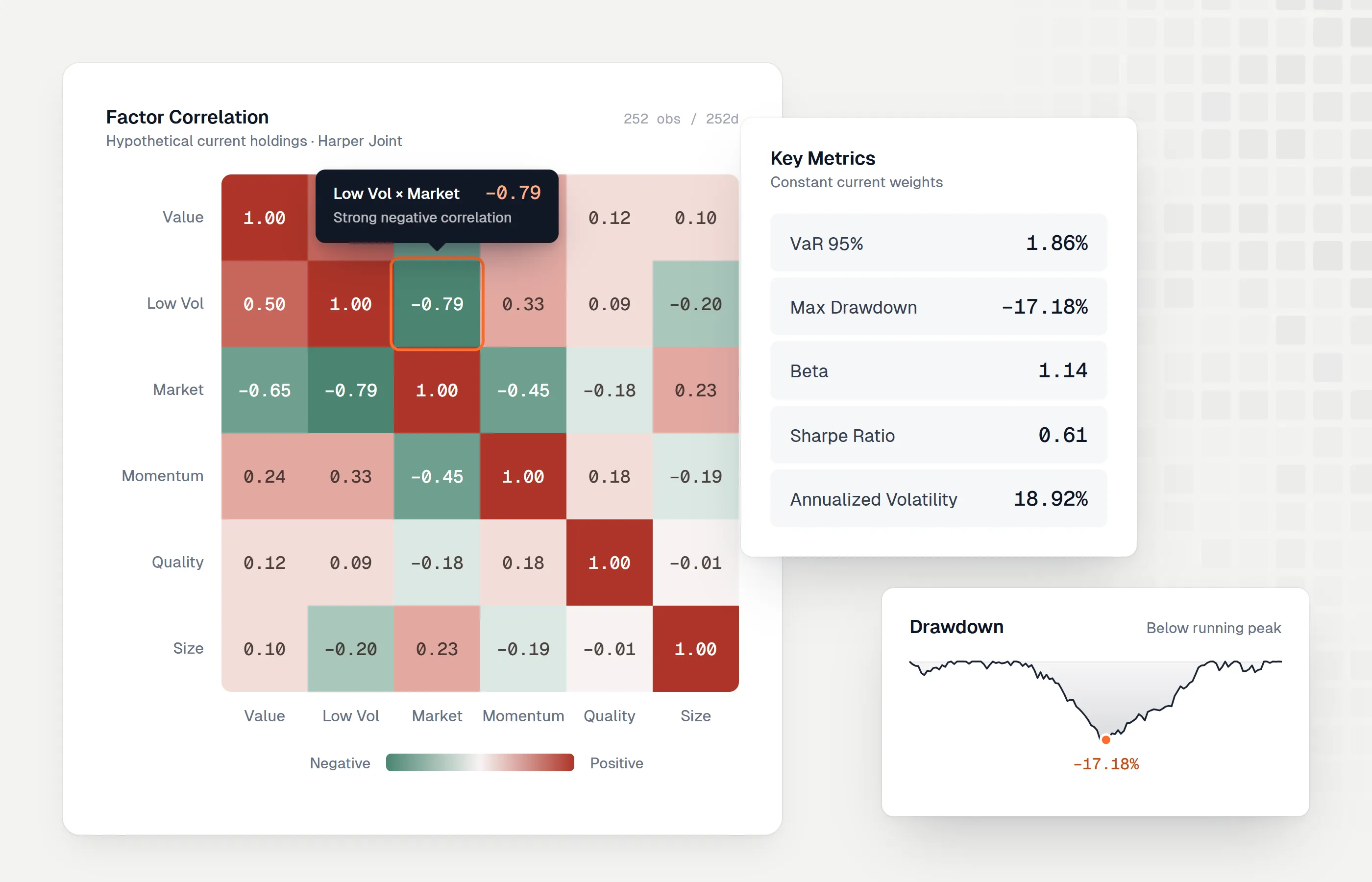
Correlation and covariance analysis can identify clusters of securities that historically moved in similar ways. Factor exposure can provide another layer by examining systematic drivers such as market sensitivity, size, value, growth, or momentum.
These tools are most useful when the platform explains the analytical period and model. Factor labels without methodology or context can create false precision.
6. Scenario Analysis and Stress Testing
Scenarios help users examine portfolio behavior under conditions that may not be visible in normal-period statistics.
A platform may support:
- Historical market periods
- Hypothetical market shocks
- Changes to rates, equity markets, currencies, or other variables
- Side-by-side scenarios across more than one portfolio
Scenario results are estimates, not forecasts. Their value comes from revealing relative vulnerabilities and creating a consistent basis for discussion.
7. Portfolio Comparison
For advisors and portfolio teams, analysis is often comparative. The relevant question is not only whether one portfolio has risk, but how it differs from another portfolio or model.
Comparison views should use consistent:
- Dates and data windows
- Benchmarks
- Currencies
- Risk methodologies
- Confidence levels
- Portfolio valuation assumptions
Without a shared basis, apparent differences can be caused by calculation settings rather than portfolio construction.
8. Monitoring, Alerts, and Reporting
Risk changes as prices, weights, volatility, and correlations change. Platforms may therefore include monitoring for selected portfolio or market conditions.
Good monitoring should be configurable and explain what triggered an alert. Reporting should make it possible to carry the relevant findings into an investment review, internal discussion, or client-facing document without forcing users to rebuild the analysis manually.
A Practical Evaluation Checklist
Before choosing a portfolio risk analytics platform, ask:
- Can it represent the portfolios and instruments you actually use?
- Are its market-data sources and calculation periods clear?
- Does it explain rather than hide its risk methodologies?
- Can you view concentration, drawdown, VaR, Expected Shortfall, correlation, factors, and scenarios in context?
- Can you compare portfolios using a consistent analytical basis?
- Can you distinguish measured facts from modeled estimates?
- Can you export or communicate the findings that matter?
- Does the workflow match an investor, advisor, research, or institutional use case?
- Does the platform avoid presenting analytics as personalized investment advice or automatic trade instructions?
The best platform is not necessarily the one with the longest feature list. It is the one that makes the relevant risks understandable and fits the decisions and conversations the user needs to support.
How Genesis Risk Monitor Fits the Category
Genesis Risk Monitor brings portfolio analysis, risk metrics, factor exposure, scenario analysis, backtesting, portfolio comparison, monitoring, model portfolios, and editable proposal creation into one workspace.
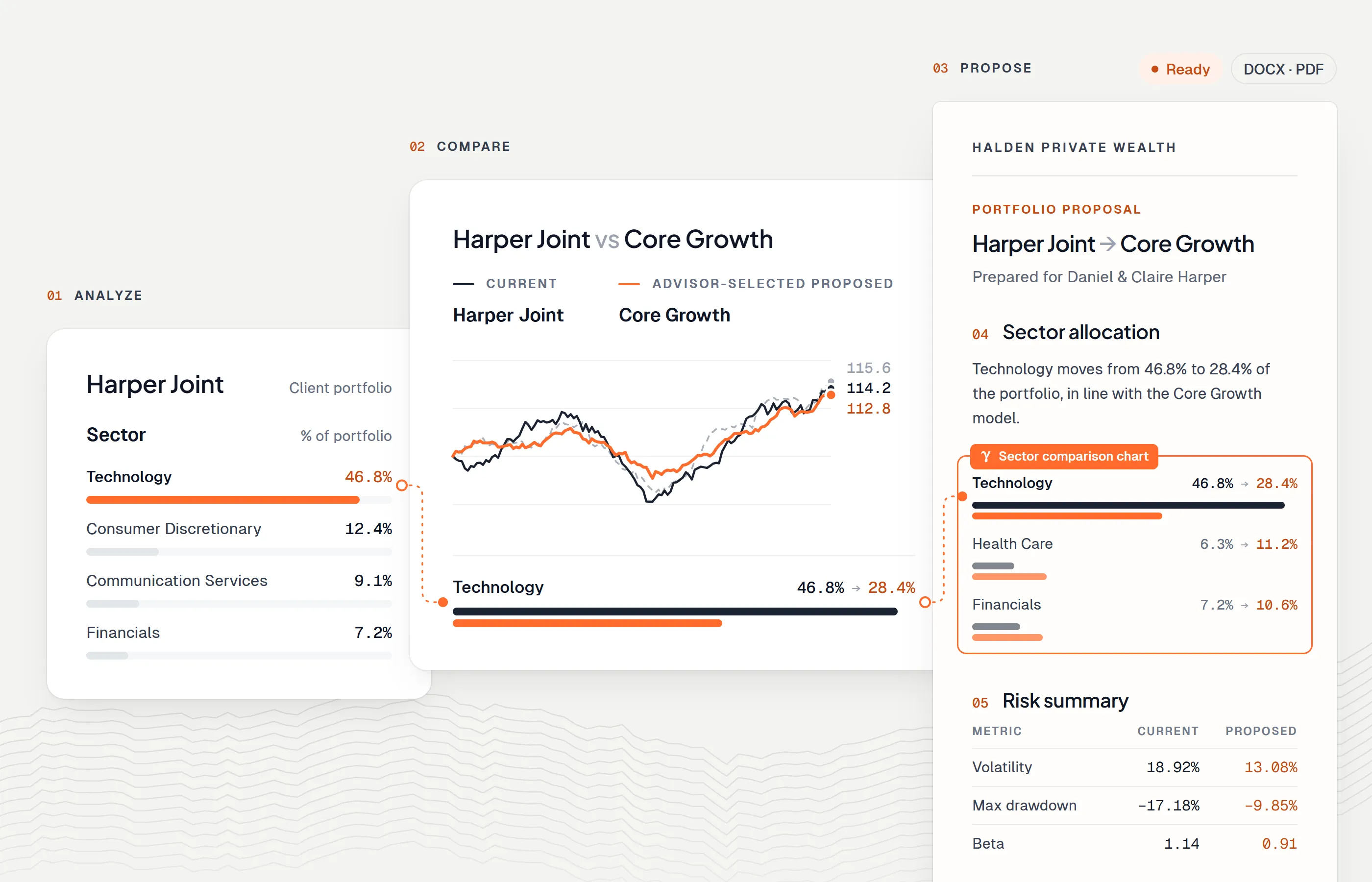
For financial advisors, the intended workflow is Analyze → Compare → Propose:
- Analyze a client or prospect portfolio.
- Compare it with other portfolios or models using a consistent basis.
- Select the findings that belong in an editable client-facing proposal.
Genesis Risk Monitor is an analytics and calculation platform. It does not provide regulated financial advice, determine suitability, or execute trades.
For the advisor-specific process, read Portfolio Risk Analytics Workflow for Financial Advisors.
Final Thoughts
A portfolio risk analytics platform should help users move from holdings to understanding.
The strongest platforms combine reliable portfolio data, transparent methodologies, multiple dimensions of risk, consistent comparisons, and a workflow for communicating the result. They do not eliminate uncertainty. They make uncertainty easier to examine, compare, and discuss.
Disclaimer: This article is for informational and educational purposes only. Risk analytics are model-based estimates and do not predict or guarantee future outcomes. Nothing in this article constitutes financial advice or an investment recommendation.
Frequently asked questions
What is a portfolio risk analytics platform?
A portfolio risk analytics platform converts portfolio holdings and market data into structured measures of concentration, volatility, drawdown, Value at Risk, Expected Shortfall, factor exposure, correlation, and scenario results. Its purpose is to help users understand where portfolio risk comes from and how it may behave under different conditions.
How is a portfolio risk analytics platform different from a portfolio tracker?
A portfolio tracker primarily records holdings, prices, and performance. A risk analytics platform goes further by calculating portfolio-level exposures, downside measures, correlations, factor sensitivities, stress tests, and monitoring signals.
Which features should a portfolio risk analytics platform include?
Core capabilities should include reliable holdings data, concentration and exposure analysis, volatility and drawdown measures, VaR and Expected Shortfall, correlation or covariance analysis, scenario testing, transparent methodology, comparable portfolio views, and exportable reporting.
Does a risk analytics platform predict future losses?
No. Risk analytics estimate possible outcomes using historical data, statistical models, and defined assumptions. They help structure uncertainty but do not predict the exact timing or size of future market losses.
What should financial advisors look for in portfolio risk software?
Advisors should evaluate whether the platform supports client, prospect, and model portfolios; provides consistent comparisons; explains methodologies clearly; allows relevant findings to be communicated; and fits into the firm's analysis and proposal workflow.