— 9 MIN
Affordable Alternatives to MSCI Barra and RiskMetrics for Portfolio Risk Analytics in 2026
Discover the best affordable alternatives to MSCI Barra (BarraOne) and RiskMetrics for portfolio risk analytics in 2026. Compare factor models, VaR, stress testing, and integrated risk and return metrics — without enterprise licensing costs.
Genesis Risk Monitor publishes this blog and develops one of the products discussed. Comparisons reflect the publisher's perspective. Confirm current features and pricing directly with each provider. Editorial policy
For most of its history, institutional-grade portfolio risk analytics has operated behind a pricing wall that most investors will never scale.
An MSCI BarraOne subscription — the benchmark risk metrics platform used by sovereign wealth funds, pension desks, and asset managers globally — can exceed $100,000 per year in enterprise licensing. Bloomberg PORT, FactSet Risk, and Axioma (now Qontigo) operate in the same tier. The result is a structural gap: the investors who arguably need rigorous portfolio risk tools the most — independent analysts, RIAs, boutique fund managers, and sophisticated retail investors — have been managing multi-million-dollar portfolios using spreadsheets and basic broker dashboards.
That gap is now closable. A new generation of portfolio tools with integrated risk and return metrics delivers the core analytical capabilities of a Barra-style multi-factor risk platform at a fraction of the cost. This guide explains what Barra and RiskMetrics actually do, what you actually need, and which affordable alternatives deliver it without enterprise overhead.
What Are MSCI Barra and RiskMetrics?
MSCI RiskMetrics is a market risk framework for calculating Value at Risk (VaR) and Expected Shortfall across financial portfolios. Originating from JPMorgan’s landmark 1994 RiskMetrics technical document, it provides the variance-covariance methodology that became the global standard for institutional risk measurement.
MSCI BarraOne extends this into a full multi-factor portfolio risk platform. It uses proprietary Barra factor models — built from decades of global equity data — to decompose total portfolio risk into contributions from systematic factors: market beta, company size, value/growth style, momentum, quality, and low volatility. What remains after factor decomposition is residual stock-specific, idiosyncratic risk.
Together, these tools answer three questions that no single performance chart can answer:
- How much risk is my portfolio actually carrying right now?
- Where is that risk concentrated — in the market, in a specific factor tilt, or in individual holdings?
- How would the portfolio perform under extreme but plausible market stress scenarios?
The reason they dominate at the institutional level is not that the mathematics is proprietary — it is not. It is that they execute these calculations automatically, continuously, across large multi-asset portfolios, with regulatory-grade audit trails. The question for independent investors is whether you need that level of infrastructure, or whether the core methodology — running the same calculations at the portfolio level — is sufficient.
For most investors outside a regulated fund structure, the latter is true. And that is the gap the new generation of affordable platforms is filling.
What You Actually Need From a Risk Metrics Platform
Before comparing platforms, it is worth identifying the specific capabilities that generate genuine analytical value — versus the enterprise features that matter primarily for regulatory compliance.
The five capabilities that matter for independent portfolio risk management:
- Multi-factor risk decomposition — breaking total portfolio volatility into market, sector, and style factor contributions
- Value at Risk (VaR) and Expected Shortfall (CVaR) — probabilistic loss estimates at defined confidence levels using historical simulation, parametric, and Monte Carlo methods
- Portfolio stress testing — scenario analysis against historical crises (2008, 2020) and hypothetical shocks (rate spike, credit widening, liquidity crisis)
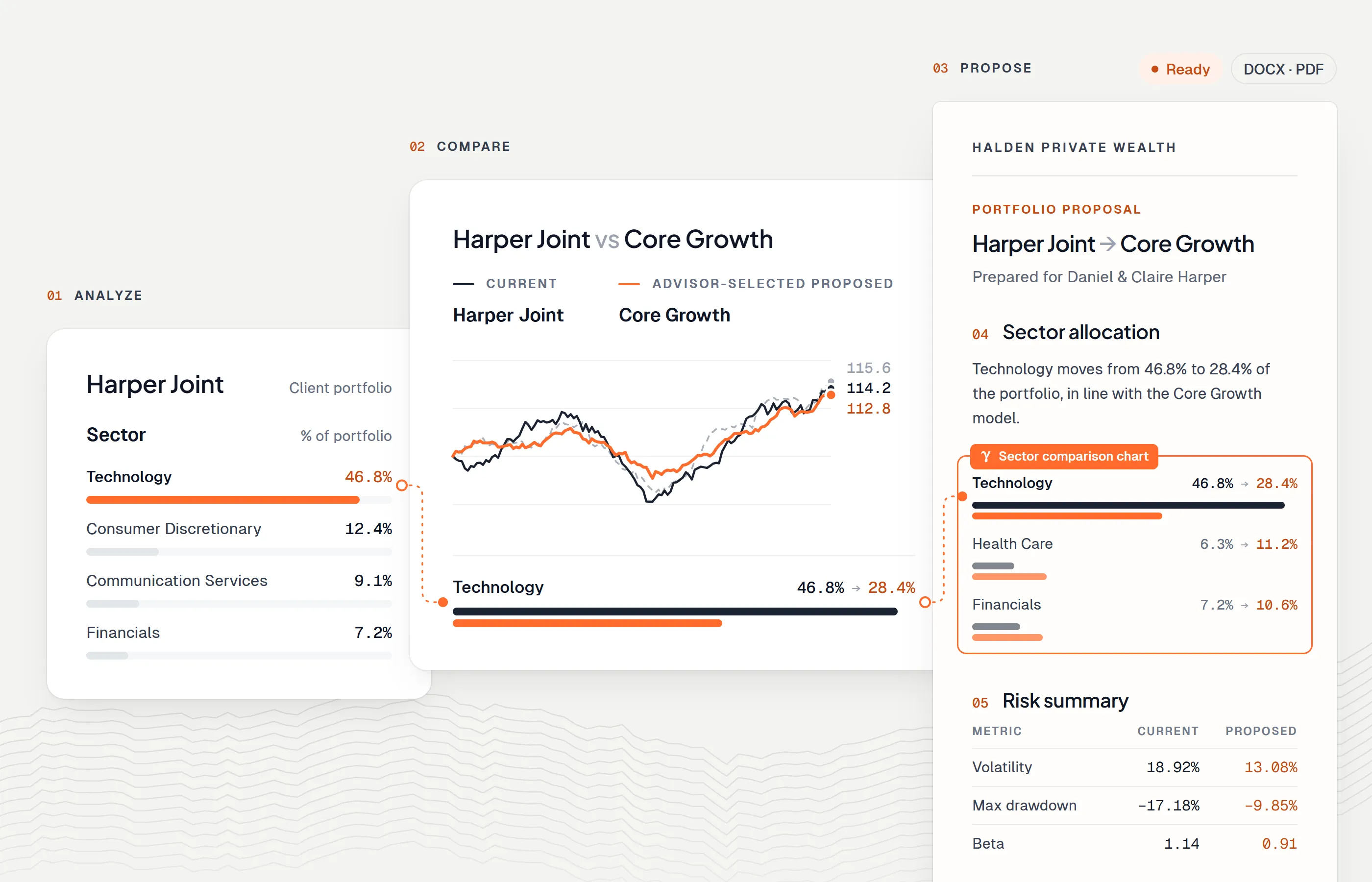
- Integrated return attribution — P&L decomposition to identify whether performance came from factor tilts, sector allocation, or stock selection
- Risk-adjusted return metrics — Sharpe, Sortino, Calmar ratios calculated against live holdings
The last two — return attribution and risk-adjusted metrics — are where most pure-risk platforms fall short. Viewing risk metrics in isolation from return metrics leaves the most important question unanswered: are you being compensated for the risk you are taking? Truly integrated risk and return metrics answer that question in one view.
Platform Comparison: Enterprise vs. Affordable Alternatives
The table below compares the leading enterprise risk platforms against accessible alternatives across the five core analytical capabilities.
| Platform | Barra-Style Factor Model | VaR / CVaR | Stress Testing | Risk & Return Integration | Approx. Cost | Target User |
|---|---|---|---|---|---|---|
| MSCI BarraOne | Full (proprietary Barra factors) | Historical / Parametric / Monte Carlo | Extensive (historical + custom) | Full P&L attribution | $50,000–$150,000+ | Institutional asset managers |
| Bloomberg PORT | Multi-factor (Bloomberg factors) | Yes (multiple methods) | Yes | Full attribution | $24,000+ (Terminal req.) | Buy-side desks |
| FactSet Risk | Multi-factor | Yes | Yes | Full attribution | $12,000–$40,000+ | Mid-size fund managers |
| Axioma / Qontigo | Full (multiple factor models) | Yes | Yes | Full attribution | $30,000–$80,000+ | Institutional |
| Genesis Risk Monitor | Barra-style (market, size, value, momentum) | Historical / Parametric / Monte Carlo | Extensive (historical + custom) | Full P&L attribution | Free – From $29/month | Independent investors, RIAs, boutique funds |
| Portfolio Visualizer | Factor regression | Monte Carlo | Historical | Return analytics | Free – From $30/month | Retail, DIY investors |
| Kwanti | Factor exposure | Yes | Yes | Yes | $249/month | RIAs |
| Nitrogen (Riskalyze) | Proprietary Risk Number | Proprietary Formula | Yes | Client-facing risk scoring | From $99/month | RIAs (client presentations) |
Understanding the Gaps in the Mid-Market
The comparison table reveals a structural gap in the mid-market. Enterprise platforms (BarraOne, Bloomberg, FactSet) cover every analytical dimension — but cost prohibitively. Free or low-cost tools (Portfolio Visualizer) offer useful historical analysis but cannot run against live holdings or produce daily portfolio risk calculations with real positions.
Nitrogen and Kwanti occupy the RIA workflow tier — useful for generating client-facing risk scores and proposal documents, but not designed for the neither provides a genuine Barra-style factor decomposition running on live portfolio data.
The specific need — portfolio tools integrated risk and return metrics, running daily against live positions, at an accessible cost — maps to a single meaningful option in 2026.
Genesis Risk Monitor: Institutional Methodology, Accessible Pricing
Genesis Risk Monitor was built specifically to close this gap. It applies the same multi-factor risk decomposition methodology used in Barra-style models — decomposing portfolio risk into market beta, size, value/growth, and momentum factor contributions — and runs it against live brokerage-connected portfolios through integrations with 20+ brokers via SnapTrade.
The risk metrics delivered include:
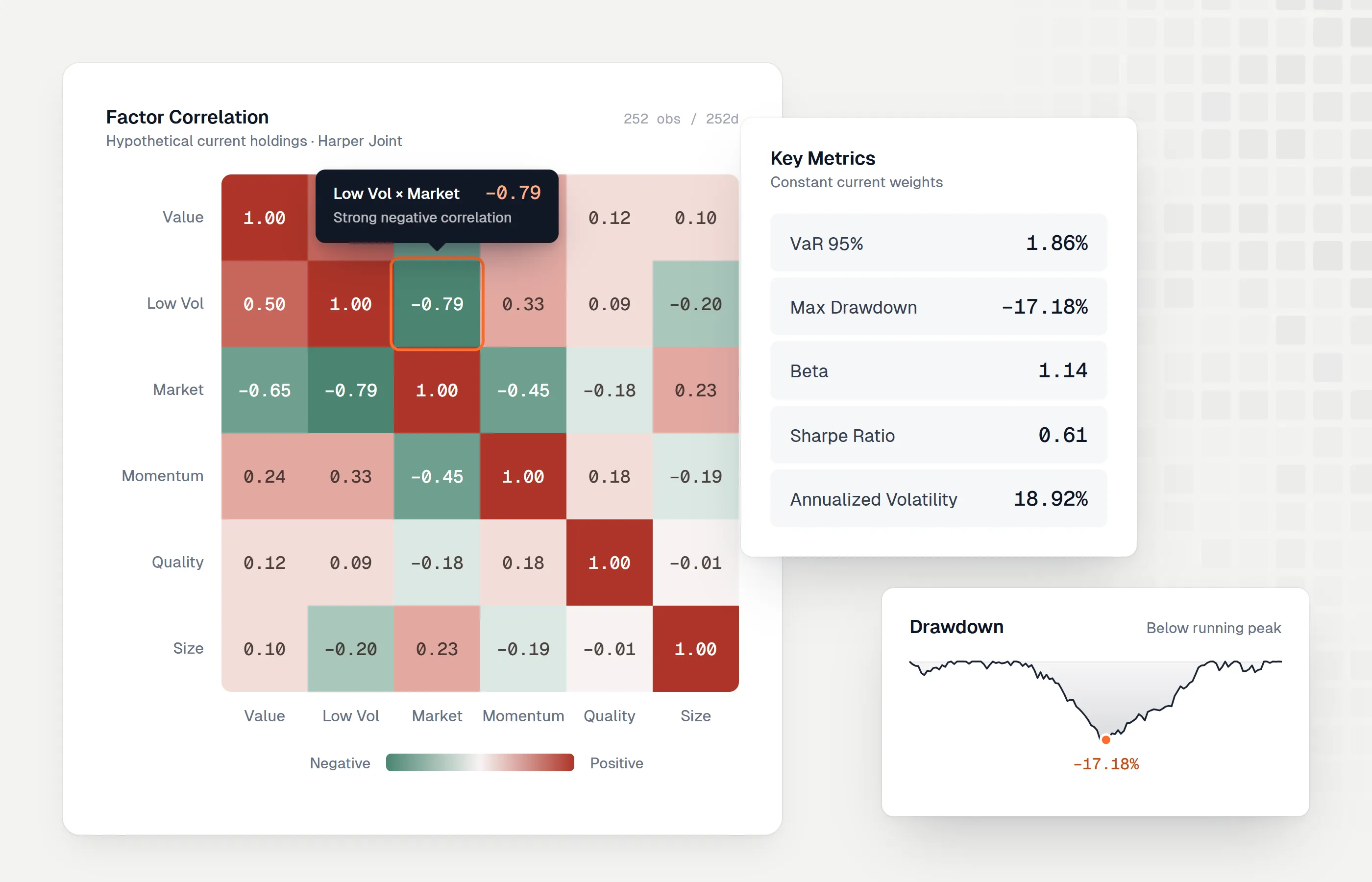
- Daily VaR (Historical Simulation, Parametric, and Monte Carlo) at 95% and 99% confidence levels
- Expected Shortfall (CVaR) — measuring average tail loss beyond the VaR threshold
- Factor Exposure heatmaps — identifying whether portfolio risk is driven by a single factor tilt (e.g., concentrated growth-momentum exposure)
- Portfolio stress tests against historical scenarios including the 2008 Global Financial Crisis, the 2020 COVID crash, and the 2022 rate shock cycle
- Sharpe and Sortino ratios calculated against actual portfolio performance for integrated risk and return analysis
- P&L Attribution — decomposing daily returns into market, factor, and idiosyncratic components
At €25 per month, Genesis Risk Monitor makes these calculations available without enterprise contracts, minimum asset thresholds, or multi-year licensing commitments.
The Right Platform for Your Use Case
The choice between platforms ultimately depends on your mandate and your primary analytical need:
- If you manage a regulated fund with UCITS or Basel IV reporting requirements, BarraOne or FactSet remain the appropriate tier — the institutional infrastructure and regulatory integration justify the cost.
- If you are an RIA focused on client-facing risk communication and proposal generation, Nitrogen addresses that specific workflow well.
- If you need historical factor regression for a specific research question, Portfolio Visualizer provides sufficient analytical depth at low cost.
- If you need daily portfolio risk monitoring against live holdings, Barra-style factor decomposition, genuine stress testing, and integrated risk and return metrics — without enterprise pricing — Genesis Risk Monitor is the direct alternative in 2026.
The mathematics behind institutional risk analytics has been public for decades. The remaining gap is execution: getting those calculations to run automatically, daily, against real positions, presented in a form that enables decision-making rather than just record-keeping. That is where the gap between platforms matters — and where the right tool transforms risk understanding into genuine portfolio discipline.
Conclusion
The absence of affordable risk metrics tools in the mid-market has forced independent investors and boutique fund managers to choose between two inadequate options: paying enterprise prices for institutional platforms they cannot justify, or operating without quantitative risk measurement at all.
Neither is acceptable for serious portfolio management. The platforms reviewed above close that gap across different use cases, but only Genesis Risk Monitor delivers the full combination of Barra-style factor decomposition, daily VaR across three methodologies, stress testing, and integrated risk and return metrics at an accessible price point.
Understanding your portfolio risk is not a luxury reserved for institutions. It is the prerequisite for every investment decision that follows.
Further Reading:
- 6 Essential Risk Analytics Tools for Investors in 2026
- Portfolio Risk Analytics Platform: VaR, Factor Exposure, and Stress Testing Compared
- How to Measure Investment Risk: VaR, CVaR, and Factor Exposure Explained
- How to Stress Test Your Portfolio
Disclaimer: The content of this article is for informational and educational purposes only and does not constitute financial advice, investment recommendations, or an endorsement of any specific security or platform. All platform pricing referenced is approximate and subject to change. Please verify current pricing directly with each vendor before making purchasing decisions.
Frequently asked questions
What is MSCI Barra (BarraOne) and why is it so expensive?
MSCI BarraOne is an enterprise multi-factor risk platform that decomposes portfolio risk into systematic factor exposures — market beta, size, value/growth, momentum, and quality — using proprietary factor models built from decades of global equity data. It also calculates Value at Risk (VaR), Expected Shortfall (CVaR), and runs stress tests against historical and hypothetical scenarios. BarraOne carries enterprise licensing costs typically ranging from $50,000 to $150,000+ per year, depending on the asset classes covered and the number of users, placing it firmly out of reach for independent investors, RIAs, and boutique fund managers.
What is the difference between MSCI RiskMetrics and MSCI BarraOne?
MSCI RiskMetrics is a market risk quantification framework, originating from JPMorgan's 1994 RiskMetrics publication, focused on Value at Risk (VaR) and Expected Shortfall calculations using variance-covariance matrices and historical simulation. MSCI BarraOne is a multi-factor portfolio risk platform that integrates the RiskMetrics risk engine with Barra factor models, enabling full portfolio-level risk decomposition, factor attribution, and performance analytics. Both are now owned by MSCI. In practice, references to 'RiskMetrics' among practitioners often mean the broader BarraOne ecosystem.
What is a Barra-style factor model and can affordable platforms replicate it?
A Barra-style factor model decomposes total portfolio risk into contributions from systematic risk factors (market, size, value, momentum, low volatility, quality) plus residual stock-specific risk. The model uses a covariance matrix of factor returns to calculate how much of a portfolio's variance comes from each factor. Affordable platforms including Genesis Risk Monitor replicate the core Barra methodology — multi-factor decomposition, factor covariance estimation, and factor-level VaR — without the proprietary data licensing overhead. The underlying mathematical approach is identical; the difference is data sourcing and licensing model.
What portfolio risk metrics should every investor track?
The six core portfolio risk metrics every investor should track are: (1) Value at Risk (VaR) — maximum probable loss at a given confidence level; (2) Expected Shortfall / CVaR — average loss in worst-case tail scenarios; (3) Portfolio Beta — sensitivity to broad market movements; (4) Factor Exposures — concentration in size, value, momentum, and quality factors; (5) Sharpe Ratio — return earned per unit of risk taken; and (6) Maximum Drawdown — the largest peak-to-trough loss over a historical period. Together, these metrics provide a complete picture of both the probability and the magnitude of loss, alongside a measure of whether risk taken is being compensated.
What are the best affordable alternatives to MSCI Barra for boutique fund managers?
The best affordable alternatives to MSCI Barra for boutique fund managers and independent investors in 2026 are: Genesis Risk Monitor (€25/month — daily VaR across three methodologies, Barra-style factor exposure, stress testing, P&L attribution, live broker integration via SnapTrade), Portfolio Visualizer (free to low-cost — historical factor regression, Monte Carlo, no live data), Kwanti (targeted at RIAs — factor risk and proposal generation, higher cost), and Riskalyze/Nitrogen (RIA-focused — proprietary Risk Number, client-facing tools). Genesis Risk Monitor is the only option in this tier that combines live portfolio data, institutional-grade risk calculations, and integrated return analytics in a single platform.
How do integrated risk and return metrics improve portfolio management?
Integrated risk and return metrics — where performance attribution and risk decomposition are calculated against the same portfolio and the same factor model — enable investors to answer the only question that truly matters: are you being paid for the risk you are taking? Viewing risk in isolation (just VaR or just factor exposure) tells you how much you might lose. Viewing return in isolation (just performance charts) tells you what you made. Integrated platforms combine both: P&L attribution breaks down whether returns came from factor tilts, sector exposure, or genuine stock selection; risk metrics confirm whether the concentration driving those returns is within acceptable bounds. This is the framework institutional desks use and the gap most retail analytics tools leave open.
Can individual investors use Barra-style factor risk analysis without an enterprise contract?
Yes. Platforms like Genesis Risk Monitor deliver multi-factor risk decomposition — including market beta, size, value/growth, and momentum factor exposures — without an enterprise licensing contract. The core mathematical methodology of Barra-style factor analysis is academically documented (originally derived from the Fama-French three-factor and Carhart four-factor models) and can be implemented with standard financial data. What enterprise platforms like BarraOne provide above this are proprietary factor data, a broader asset class universe, and regulatory reporting integrations. For equity portfolio risk management, the core factor decomposition is fully replicable at accessible price points.
What is the most important risk-adjusted return metric for portfolio management?
The Sharpe Ratio is the most widely used risk-adjusted return metric: it measures excess return above the risk-free rate per unit of annualised portfolio volatility. A Sharpe Ratio above 1.0 is generally considered good; above 2.0 is exceptional. However, the Sharpe Ratio assumes normally distributed returns and penalises upside and downside volatility equally. For portfolios with asymmetric return profiles — including those using options or systematic strategies — the Sortino Ratio (which penalises only downside volatility) and the Calmar Ratio (return relative to maximum drawdown) are more informative complements. Professional risk platforms calculate all three alongside VaR to give a complete picture of risk-adjusted performance.