— 5 MIN
Client Acquisition Strategies for Financial Advisors: Build Trust and Demonstrate Value
Discover how financial advisors can attract clients, demonstrate value, build trust, and support AUM growth through personalized portfolio analysis.
At a glance
Understand how transparent portfolio analysis, client-specific comparisons, and personalized proposals can strengthen financial advisor prospect conversations and client trust.
Client acquisition is one of the biggest challenges facing independent financial advisors. Prospects have more investment information than ever, but access to information does not necessarily translate into confidence.
Effective client acquisition strategies for financial advisors focus on demonstrating expertise, building trust, and showing prospective clients how personalized advice addresses their investment concerns.
Genesis Risk Monitor helps advisors support these conversations with portfolio analysis, model comparisons, risk visualizations, and personalized investment proposals.
Rather than relying exclusively on performance claims, advisors can demonstrate how they evaluate investment portfolios and explain the risks clients face.
Why Trust Matters More Than a Sales Pitch
Research suggests that investors value clarity and transparency when choosing and evaluating financial advisors.
According to Avaloq’s 2025 wealth management research:
- 75% of surveyed Swiss investors considered clear communication essential to establishing trust.
- 59% considered investment analytics and real-time portfolio visualization essential for building trust.
- 49% valued seeing the impact of investment decisions on their portfolios during live meetings.
Although these findings concern Swiss investors, they illustrate the importance of making investment decisions understandable.
For financial advisors, the opportunity is to show expertise through evidence rather than simply describe it.
1. Demonstrate Value Beyond Investment Performance
How financial advisors demonstrate value to clients remains a critical question.
A 2022 NextWealth study found that 73% of 427 surveyed UK financial advisers documented portfolio performance to demonstrate the value of their advice.
However, investment performance alone cannot capture financial planning, risk management, behavioral coaching, or ongoing support.
More recent Morningstar research, published in October 2026, found that U.S. advisors identified personalized service, responsiveness, and long-term relationships among the most effective ways to justify advisory fees.
Advisors can demonstrate their contribution by explaining:
- Which investment risks they have identified.
- How portfolios align with the client’s objectives.
- Why an alternative allocation deserves consideration.
- What ongoing monitoring and professional oversight provide.
Genesis Risk Monitor supports the portfolio-analysis elements of these conversations.
2. Turn Prospect Meetings Into Personalized Conversations
A prospective client may arrive with investments accumulated across multiple accounts, funds, or previous advisory relationships.
Instead of immediately presenting a model portfolio, advisors can begin by understanding the prospect’s existing investments.
Genesis Risk Monitor helps advisors review portfolio allocation, concentration, historical performance, and risk exposures.
For example, an advisor may identify that several investments share similar market exposures despite appearing diversified.
Discussing that finding creates an opportunity to demonstrate analytical expertise without claiming that the existing portfolio is necessarily inappropriate.
The purpose is to make the first conversation relevant to the prospect.
For a detailed walkthrough of the analysis process, see How to Analyze a Prospect’s Portfolio Before the First Proposal.
3. Use Portfolio Transparency to Build Client Trust
Clients are more likely to understand investment recommendations when advisors explain the evidence behind them.
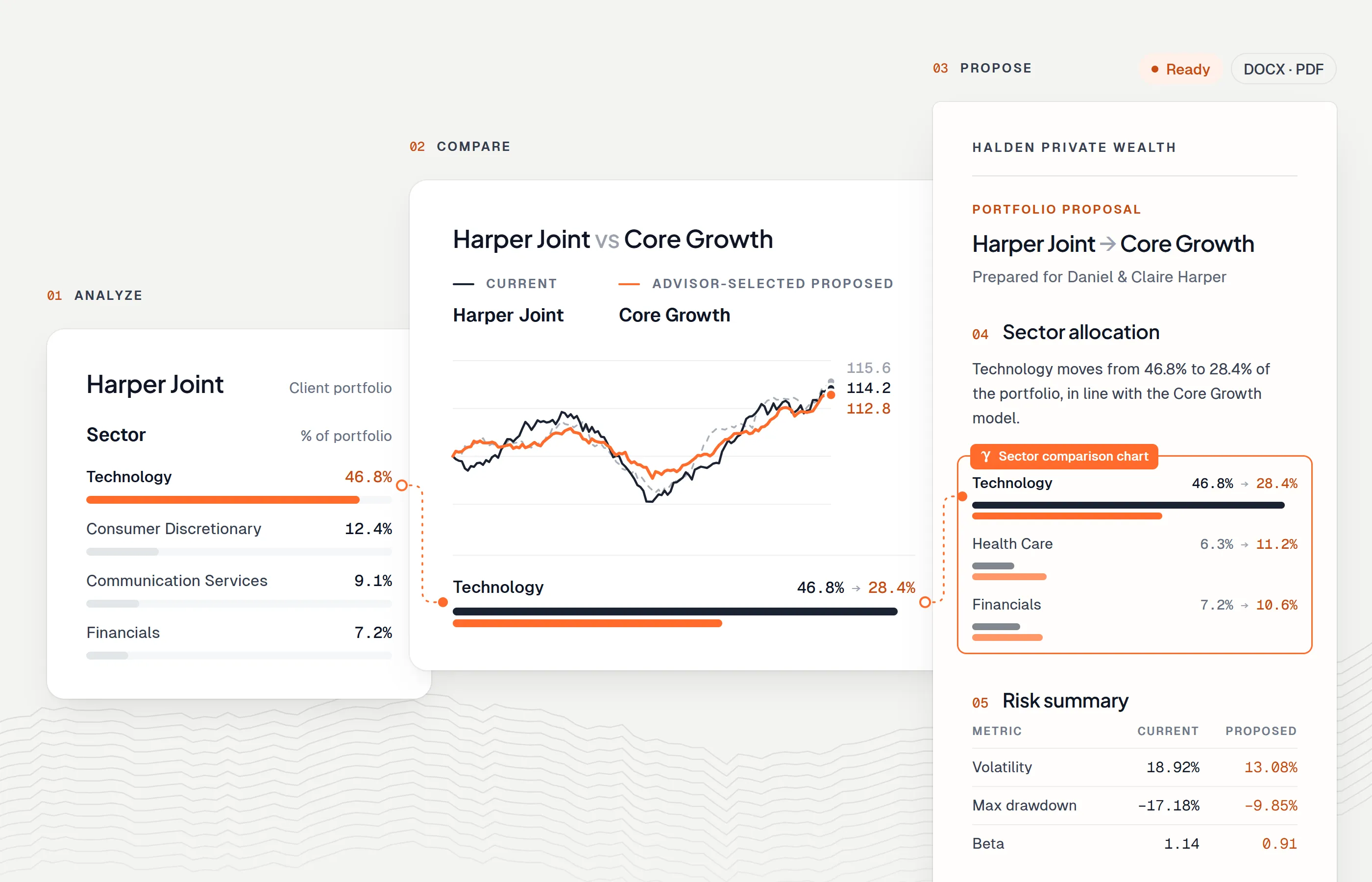
Genesis Risk Monitor allows advisors to compare existing portfolios with advisor-created models across supported allocation, risk, exposure, and performance characteristics.
These comparisons can be reviewed during meetings to illustrate differences between approaches.
For example, an advisor might explain that a proposed allocation reduces exposure to one sector while increasing exposure elsewhere.
That is more informative than describing one portfolio as simply better or safer.
Portfolio transparency for clients means showing both potential benefits and relevant trade-offs.
Genesis Risk Monitor does not select suitable investments or models on the advisor’s behalf.
4. Personalize Investment Proposals
A personalized investment proposal should reflect the client’s existing holdings, objectives, concerns, and the advisor’s investment approach.
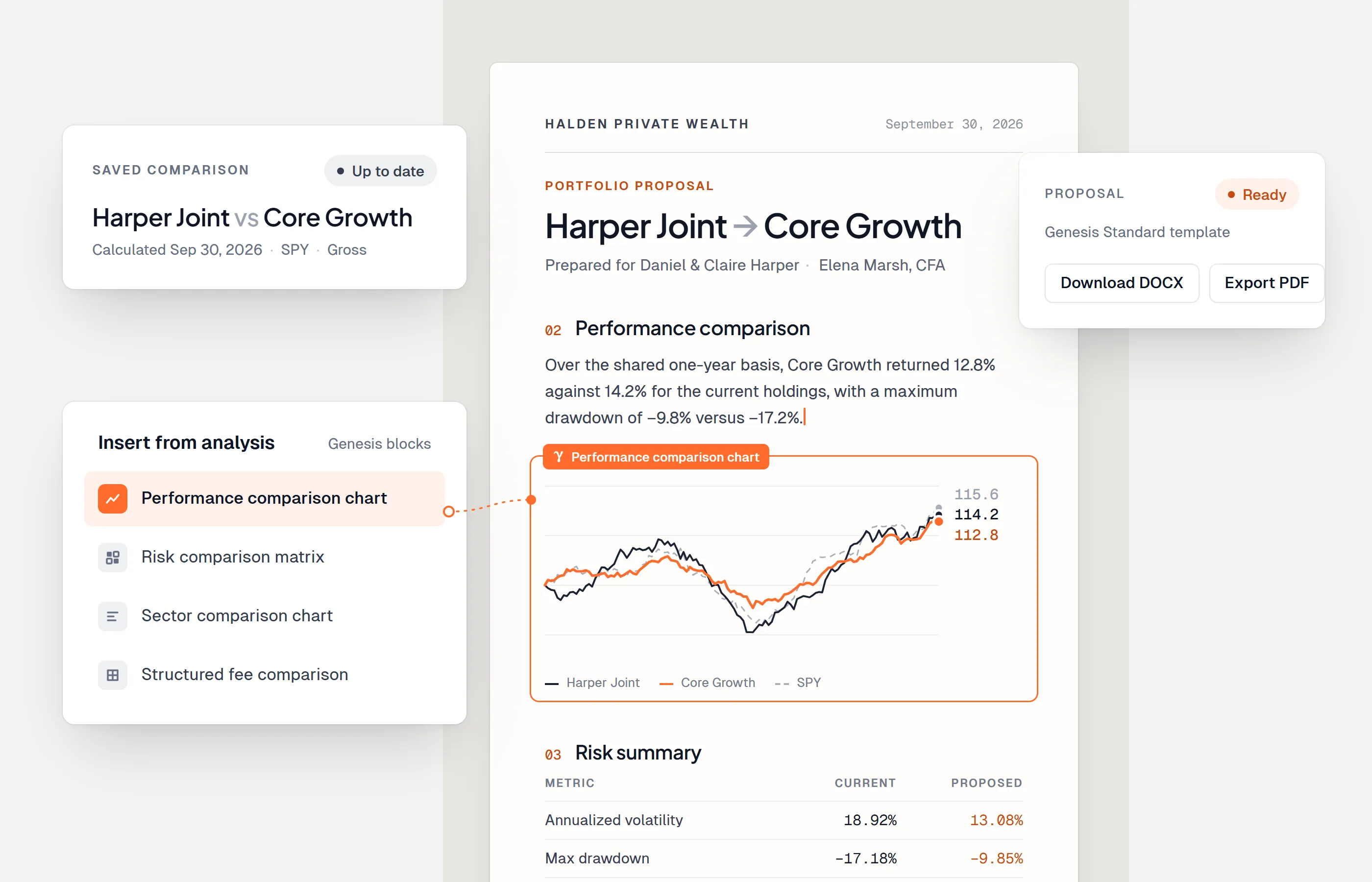
With Genesis Risk Monitor, advisors can carry supported analytical findings into editable proposals containing charts, tables, and customized commentary.
The advisor can adjust the narrative, apply supported branding, and export the document to Word or PDF.
This gives prospects a tangible explanation of the work behind the proposed strategy.
How Portfolio Analysis Supports Client Acquisition
| Client acquisition stage | What prospects want | How Genesis Risk Monitor supports the advisor |
|---|---|---|
| Initial conversation | Confidence that their situation is understood | Existing portfolio analysis |
| Discovery | Clarity about current investment risks | Risk and exposure visualizations |
| Strategy discussion | Understanding of possible alternatives | Advisor-created model comparisons |
| Proposal | A personalized explanation | Editable investment proposals |
| Ongoing relationship | Transparency and regular oversight | Portfolio monitoring and repeatable reviews |
5. Support Long-Term AUM Growth Through Stronger Relationships
Growing assets under management depends on acquiring clients, retaining existing relationships, and earning additional client assets.
Clear investment conversations can support these objectives, although better reporting does not guarantee higher conversion rates or AUM.
Recurring portfolio reviews give advisors opportunities to revisit investment assumptions, discuss relevant risks, and demonstrate continued attention to client portfolios.
A consistent, personalized service experience may also support referrals and client retention.
Frequently Asked Questions
What are effective client acquisition strategies for financial advisors?
Effective strategies include referrals, niche specialization, educational content, personalized prospect meetings, and transparent demonstrations of advisory expertise.
How can financial advisors demonstrate value to prospective clients?
Advisors can demonstrate value by analyzing existing portfolios, explaining relevant risks, evaluating alternatives, and connecting investment decisions with client objectives.
Can Genesis Risk Monitor help convert prospects into clients?
Genesis Risk Monitor helps advisors prepare evidence-based portfolio conversations and personalized proposals. Actual conversion depends on factors including suitability, service quality, pricing, and the client relationship.
How can financial advisors grow AUM?
Advisors can support AUM growth through client acquisition, retention, referrals, and deeper existing relationships. Clear communication and consistent investment reviews can strengthen these efforts.
Build Trust Before Asking for Commitment
Successful client acquisition begins with understanding, not persuasion.
By helping advisors explain portfolio risks, communicate investment trade-offs, and deliver personalized proposals, Genesis Risk Monitor supports a more transparent advisory experience.
Show clients the reasoning behind your advice—not just the results.
Explore Genesis Risk Monitor for Financial Advisors