— 5 MIN
Wealth Management Technology: How Financial Advisors Can Reduce Workflow Friction
Learn how connected wealth management technology reduces fragmented workflows, duplicate analysis, and manual work across portfolio research and reporting.
At a glance
Explore where fragmented investment tools create duplicate work and how connecting research, portfolio risk analysis, models, and proposals can improve advisor workflows.
Financial advisors have access to more investment technology than ever. Yet everyday tasks can still involve moving data between applications, repeating calculations, and rebuilding information for client meetings.
The problem is often not a lack of software. It is a lack of continuity between the tools already being used.
Connected wealth management technology improves advisor workflow efficiency by reducing the repeated work between portfolio research, risk analysis, model management, monitoring, and client reporting.
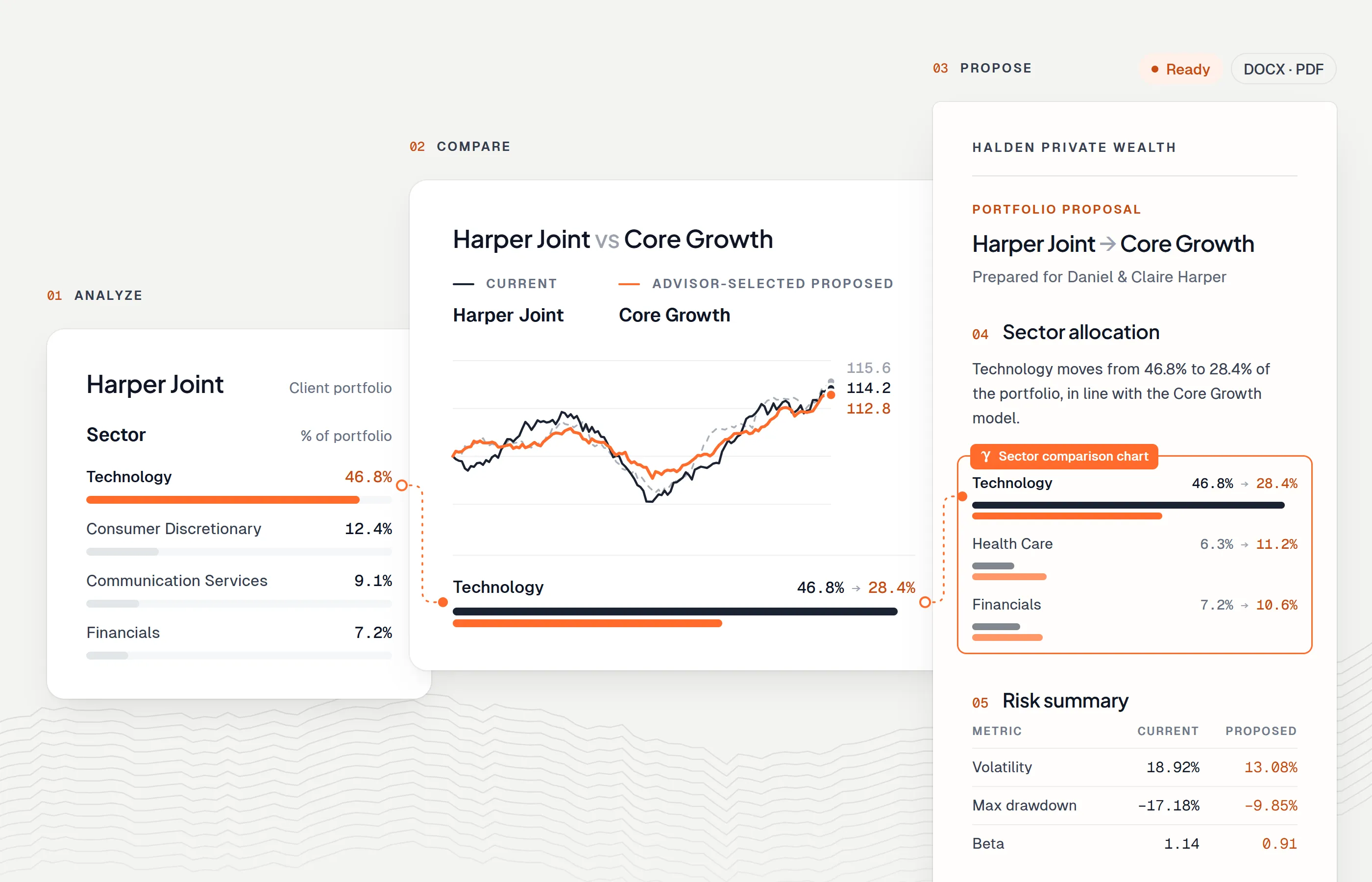
Genesis Risk Monitor addresses these investment-related activities within one platform, helping advisors move between analysis and client communication without repeatedly reconstructing their work.
The Real Cost of Fragmented Technology
According to Cerulli Associates’ 2024 research, U.S. financial advisors identified several challenges to effectively using technology:
- 71% cited insufficient integration between tools and applications.
- 70% reported insufficient time to learn and implement technology.
- 73% identified compliance restrictions limiting software functionality.
These findings highlight a challenge for independent advisory practices.
Adding another specialized application may solve one problem while creating additional operational complexity.
An Avaloq study published in 2025 found that 59% of surveyed Swiss wealth managers said their technology systems did not work seamlessly together.
For smaller advisory firms with limited operational resources, these disconnected processes can place additional pressure on productivity.
1. Identify Where Investment Work Gets Repeated
Fragmented workflows often become visible during routine portfolio reviews.
An advisor might review company fundamentals in one platform, calculate portfolio risks in another, maintain model allocations in a spreadsheet, and prepare client documents in Word.
The challenge is not necessarily that any individual application performs poorly.
The problem is that the same information may need to be transferred or interpreted repeatedly.
These handoffs can introduce inconsistent assumptions, outdated figures, formatting issues, and additional review work.
A useful starting point is identifying which tasks require unnecessary data movement.
2. Connect Investment Research With Risk Analysis
Investment research becomes more valuable when advisors can evaluate how their findings relate to portfolio exposures.
Genesis Risk Monitor provides supported market and fundamental research alongside portfolio risk analytics.
Advisors can investigate company information, financial statements, and market data while working within the same broader environment used for portfolio analysis.
They can then examine portfolio concentration, volatility, factor exposures, drawdowns, Value at Risk, and stress scenarios.
It reduces the separation between investment information and portfolio-level analysis.
3. Keep Model Portfolios Connected to Review Activity
Advisor-created model portfolios provide a consistent analytical reference for evaluating investment strategies.
However, maintaining models separately from client portfolios can create unnecessary work.
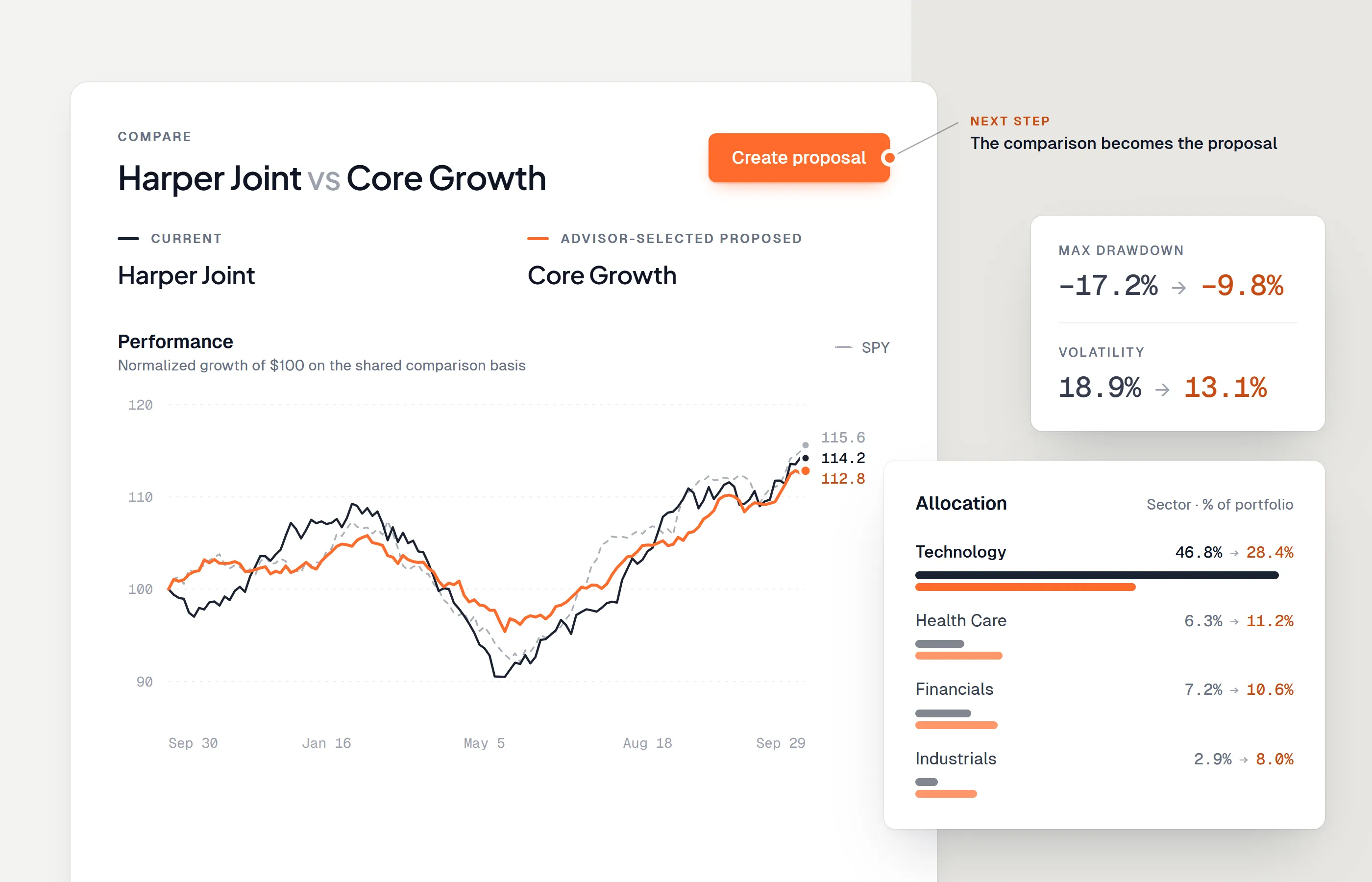
Genesis Risk Monitor allows advisors to manage model allocations and compare relevant characteristics with existing client or prospect portfolios.
Supported comparisons include allocation differences, risk, exposure and historical performance.
For linked portfolios, advisors can also review allocation drift.
This helps preserve consistency between the models advisors manage and the evidence used during reviews.
Investment decisions, suitability assessments, and trade execution remain outside the platform’s automated responsibilities.
Where Fragmentation Creates Unnecessary Work
| Workflow problem | Potential consequence | Connected approach |
|---|---|---|
| Separate portfolio data sources | Repeated holdings preparation | Supported portfolio imports and read-only connections |
| Disconnected research and analytics | More application switching | Research alongside portfolio analysis |
| Models maintained independently | Repeated comparisons and assumption checks | Reusable advisor-created models |
| Separate risk reporting tools | Inconsistent analytical context | Connected risk and scenario views |
| Manual document preparation | Charts and findings reconstructed | Editable proposals using supported portfolio evidence |
These are potential workflow improvements rather than independently measured productivity gains.
4. Reduce Manual Work Between Analysis and Client Communication
Research and risk analysis only deliver their full value when findings can be communicated clearly.
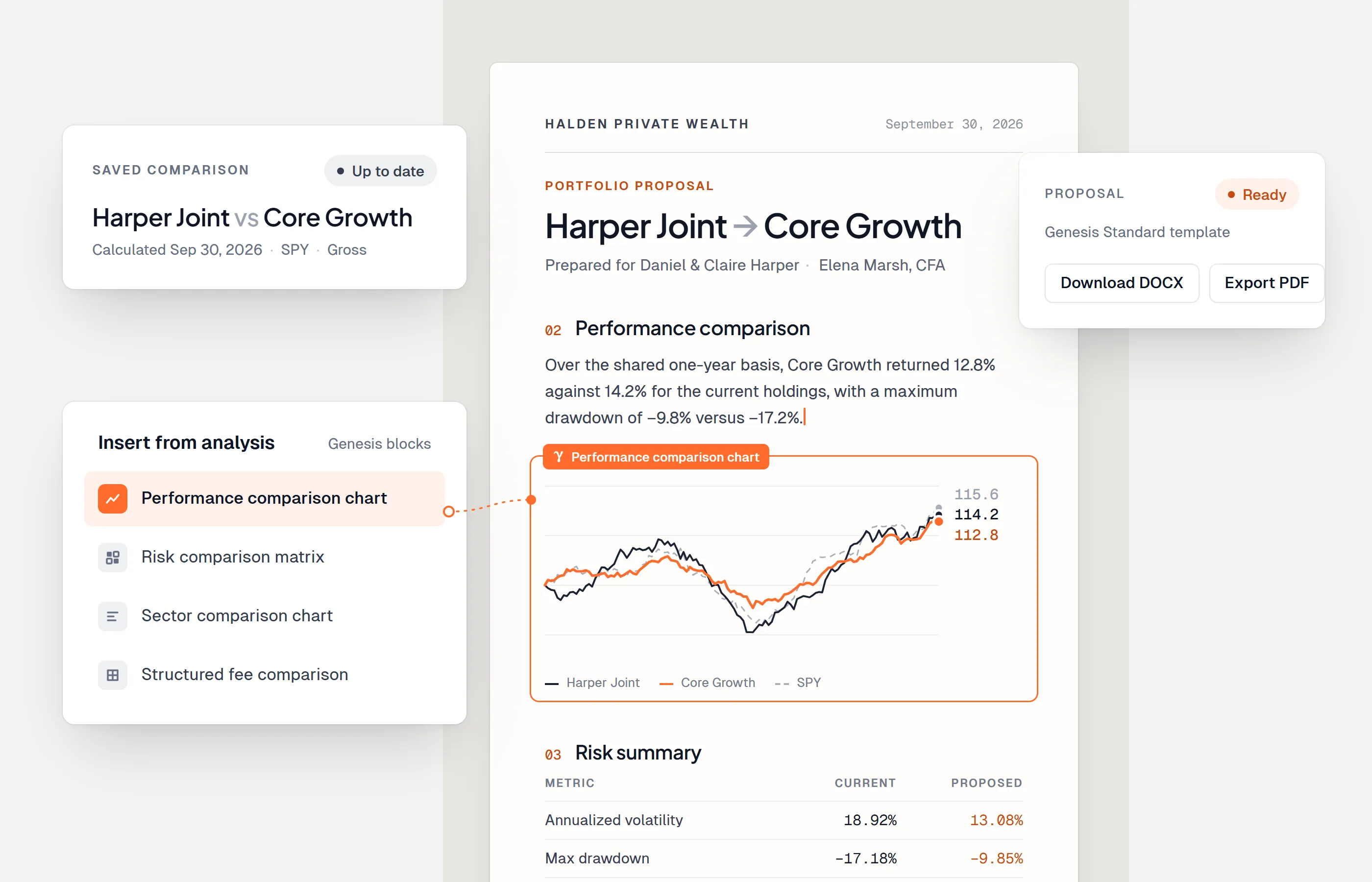
Genesis Risk Monitor’s Proposal Builder supports the transition from completed portfolio analysis to an editable client-facing document.
Advisors can work with supported tables, charts, narrative sections, and proposal templates before exporting to Word or PDF.
This helps reduce repeated document assembly while preserving control over the final communication.
For a detailed explanation of the prospect-to-proposal process, see From Prospect Portfolio to Client Proposal.
5. Choose Connected Workflows Without Replacing Everything
An efficient advisor technology environment does not require one provider to replace every system.
| Technology category | Primary responsibility |
|---|---|
| CRM | Client records, relationships, and follow-ups |
| Financial planning software | Goals, cash flows, and long-term planning |
| Custodian and trading systems | Account custody and trade execution |
| Genesis Risk Monitor | Investment research, risk analysis, models, monitoring, and proposals |
| Compliance systems | Oversight, records, and regulatory workflows |
Genesis Risk Monitor complements these operational systems rather than replacing them.
Advisors evaluating the wider technology ecosystem can read The Financial Advisor Technology Stack: 7 Digital Tools for Independent RIAs.
Frequently Asked Questions
What causes fragmented workflows in wealth management?
Common causes include disconnected applications, duplicate data entry, inconsistent analytical assumptions, limited integrations, and separate reporting processes.
How can financial advisors improve workflow efficiency?
Advisors can identify repetitive tasks, reduce unnecessary application switching, use reusable analytical frameworks, and connect portfolio analysis with client reporting.
Is Genesis Risk Monitor an all-in-one wealth management platform?
Genesis Risk Monitor combines multiple investment research, portfolio analytics, monitoring, and proposal capabilities. It does not replace CRM, comprehensive financial planning, custody, or trading systems.
What is the difference between technology integration and workflow consolidation?
Technology integration connects separate applications through data exchange. Workflow consolidation brings related activities together within one environment, potentially reducing the number of handoffs required.
Make Existing Technology Work More Effectively
Advisory firms do not necessarily need more applications. They need fewer unnecessary steps between essential investment tasks.
Genesis Risk Monitor helps connect portfolio research, analysis, model comparisons, monitoring, and client proposals.
The goal is not to consolidate every application. It is to eliminate the repeated work between the tools advisors depend on.
Explore the Genesis Risk Monitor Platform