— 5 MIN
Client-Friendly Portfolio Risk Reports: Explaining Investment Risk During Market Volatility
Learn how to prepare client-friendly portfolio risk reports, explain market volatility, and support better investment conversations with Genesis Risk Monitor.
At a glance
Learn how portfolio-specific risk analysis and stress scenarios help advisors explain volatility and prepare understandable client-facing risk reports.
Market volatility is inevitable, but understanding how it affects an individual investment portfolio is not always straightforward.
When markets decline, clients may worry about losing savings, delaying retirement, or making the wrong investment decision.
Financial advisors must respond with more than market commentary. They need to explain what is happening within the client’s portfolio and how those risks relate to the client’s circumstances.
A client-friendly portfolio risk report translates portfolio analytics, historical losses, risk exposures, and stress scenarios into clear information that supports informed investment conversations.
Genesis Risk Monitor helps financial advisors prepare this evidence through portfolio analytics, scenario analysis, and editable client-facing documents.
Why Clear Risk Communication Matters
According to Capital Group’s 2025 analysis, since 1950, the S&P 500 has historically experienced:
- A decline of 10% or more approximately once per year.
- A decline of 20% or more approximately every six years.
These are historical averages, not predictions of when future declines will occur.
Meanwhile, a 2025 Gallup survey found that 60% of surveyed U.S. investors were concerned about market volatility.
Yet only 21% reported contacting a financial professional for advice since that period of volatility began.
The survey included U.S. adults with at least $10,000 invested, rather than only existing advisory clients.
1. Explain What Market Volatility Means for the Client’s Portfolio
Genesis Risk Monitor allows advisors to review risk metrics, portfolio exposures, historical drawdowns, and relevant allocation characteristics.
An advisor might identify that a client holds several funds with significant exposure to similar companies or sectors.
Rather than saying that the portfolio is diversified simply because it contains multiple funds, the advisor can explain its underlying concentration.
2. Use Stress Testing to Illustrate Portfolio Vulnerabilities
Portfolio stress testing for financial advisors helps investigate how current holdings might behave under selected adverse market conditions.
Genesis Risk Monitor supports historical scenario analysis and available custom stress scenarios.
Advisors can use these scenarios to discuss possible vulnerabilities and explore how different portfolios respond to selected assumptions.
For example, a scenario involving rising interest rates may help illustrate sensitivity within a bond-heavy portfolio.
The important distinction is that a stress test is a modeled scenario, not a forecast.
Historical data, assumptions, and changing market relationships limit what the results can establish.
For a technical explanation of stress testing methods, see How to Stress Test Your Portfolio.
3. Turn Technical Findings Into Client-Friendly Explanations
A client-friendly portfolio risk report should answer the questions investors actually ask.
| Client question | Useful report evidence | Advisor communication objective |
|---|---|---|
| Why did my portfolio decline? | Performance and allocation analysis | Explain relevant drivers of the change |
| Am I taking too much risk? | Volatility, concentration, and downside-risk measures | Discuss risk in the context of goals and capacity |
| What could happen in another downturn? | Historical stress scenarios | Illustrate potential vulnerabilities |
| Is my portfolio sufficiently diversified? | Asset allocation and exposure analysis | Explain underlying concentration |
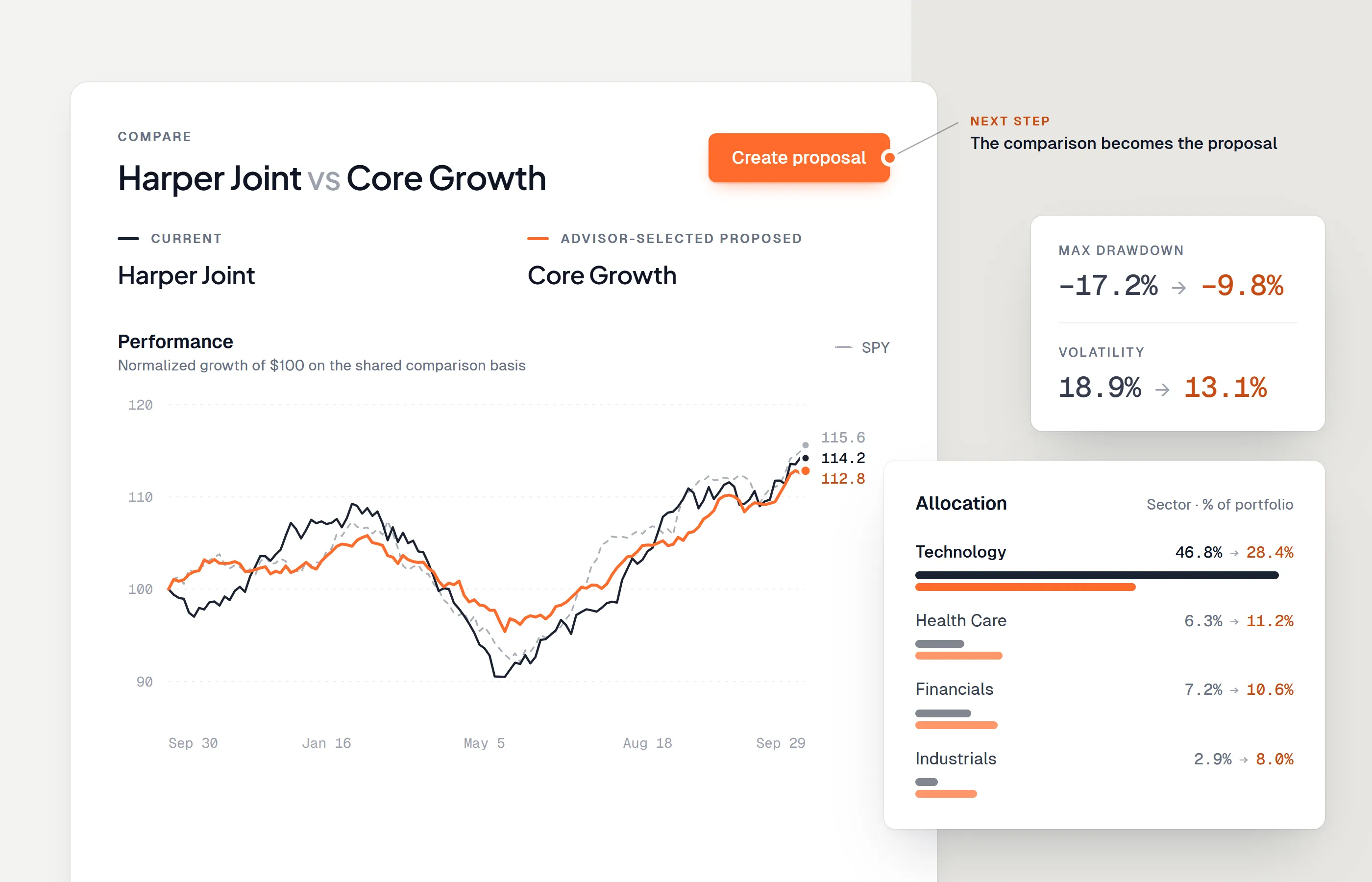
| Should we change the portfolio? | Current portfolio and model comparisons | Discuss alternatives and trade-offs |
The report should include a clear analytical period, material assumptions, and appropriate disclosures.
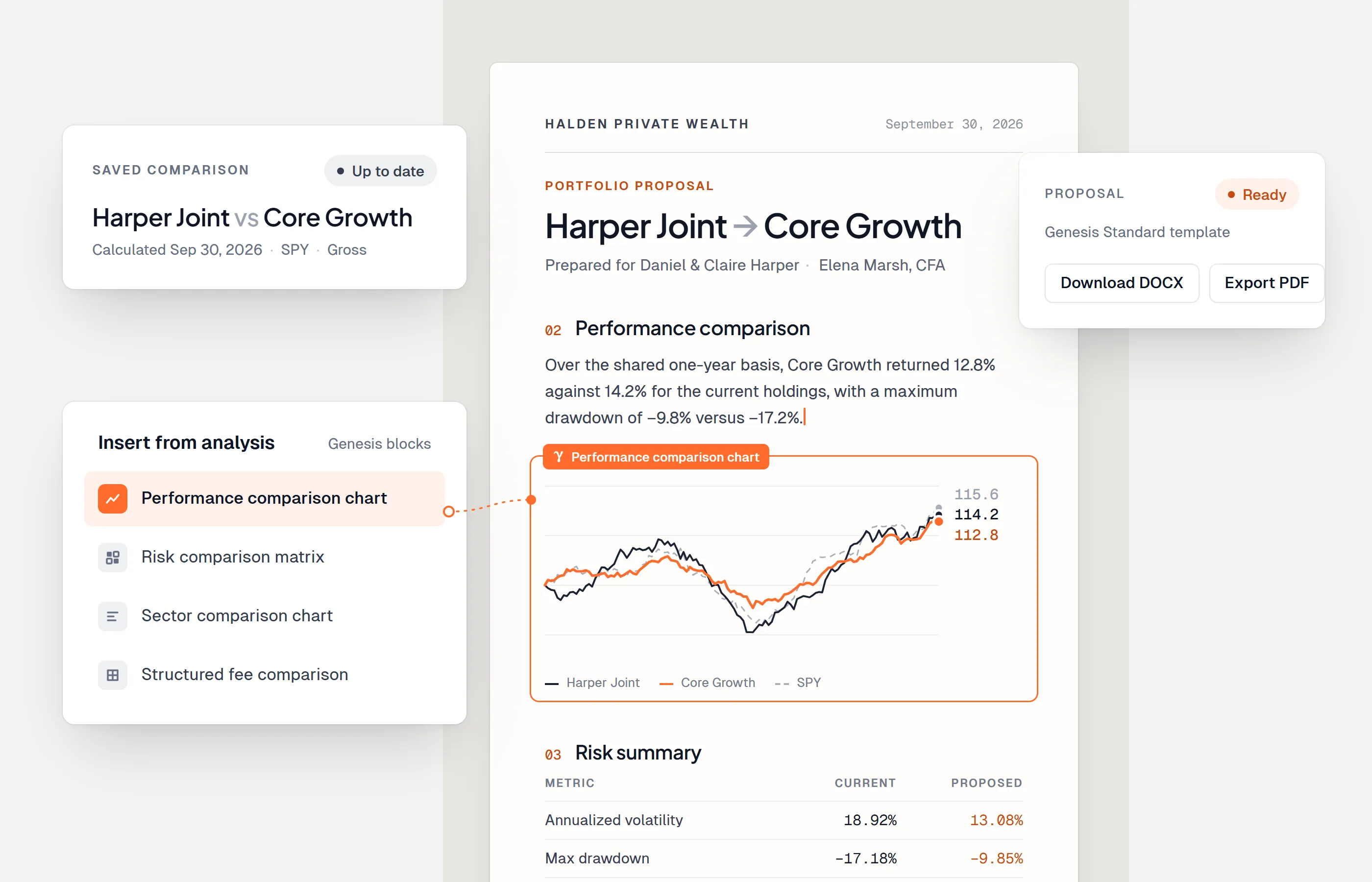
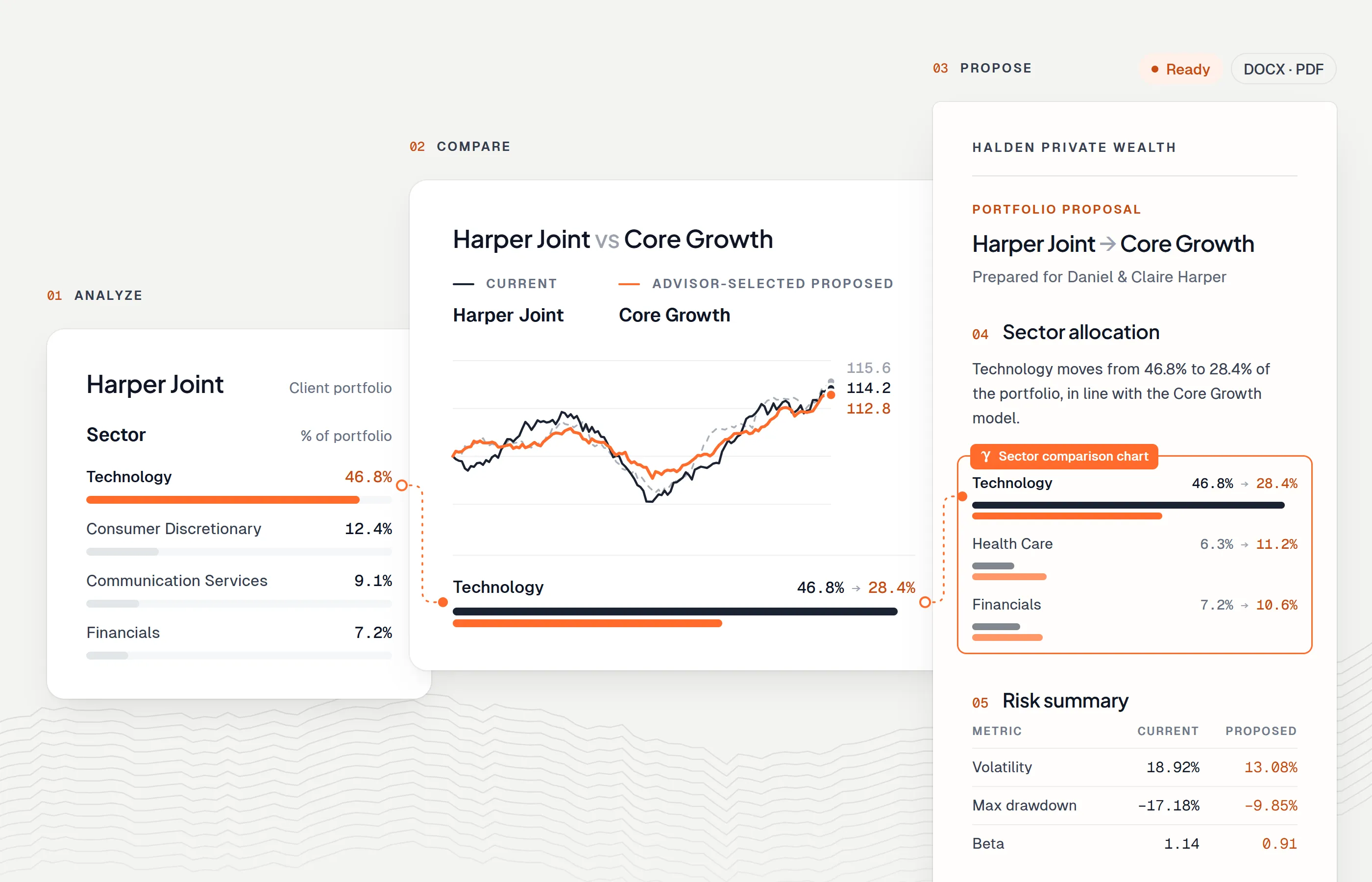
Genesis Risk Monitor’s Proposal Builder helps advisors carry supported tables, charts, and analytical findings into an editable client document.
The advisor remains responsible for interpreting the evidence and determining whether any action is appropriate.
4. Connect Portfolio Risk With the Client’s Circumstances
An investment portfolio can have measurable risk characteristics without necessarily being appropriate or inappropriate for a specific client.
A meaningful conversation considers risk tolerance, financial risk capacity, investment horizon, liquidity needs, and financial objectives.
Portfolio analytics can help identify exposure to potential losses.
The advisor must then assess those findings against the client’s broader financial situation.
For a detailed explanation, read Risk Tolerance vs. Risk Capacity: A Practical Guide for Financial Advisors.
5. Help Clients Manage Emotional Reactions
Research suggests that client emotions can make investment advice more difficult to deliver.
Morningstar’s 2026 Investor Perspectives for Advisors found that 36% of surveyed U.S. advisors identified client behavior and emotional decision-making as a barrier to providing advice.
Among those advisors, 61% identified emotional reactions to market news as a contributing issue.
A practical approach is to acknowledge concerns, explain the portfolio’s actual exposures, illustrate relevant scenarios, review investment objectives, and document agreed next steps.
A report should support the conversation rather than replace it.
Frequently Asked Questions
What is a client-friendly portfolio risk report?
A client-friendly portfolio risk report explains investment exposures, potential vulnerabilities, and relevant risk metrics through understandable charts, contextual information, and advisor commentary.
How can financial advisors explain portfolio risk to clients?
Advisors can use portfolio-specific analysis, historical drawdowns, concentration information, and stress scenarios while explaining limitations and connecting results to client goals.
How should advisors talk to clients about market volatility?
Advisors should acknowledge client concerns, provide historical context, explain portfolio-specific risks, and discuss whether the current investment approach remains aligned with the financial plan.
Can Genesis Risk Monitor generate client-ready risk reports?
Genesis Risk Monitor provides risk analytics and supports incorporating portfolio findings into editable proposals with tables, charts, and narrative. Advisors can customize the documents and export them to Word or PDF.
Can stress testing predict future portfolio losses?
No. Stress testing explores modeled outcomes under specified scenarios. Actual market outcomes may differ substantially.
Make Portfolio Risk Easier to Understand
Financial advisors cannot prevent market downturns, but they can help clients understand investment risk before and during periods of uncertainty.
Genesis Risk Monitor provides portfolio analytics, stress testing, and editable reporting tools to support these conversations.
A useful risk report does more than display numbers. It helps clients understand their exposure, evaluate trade-offs, and discuss decisions with greater confidence.
Explore Genesis Risk Monitor Portfolio Risk Analytics