— 12 MIN
How to Identify Where Your Investment Risk Actually Comes From
Learn how to analyze your portfolio and identify exactly where your investment risk is coming from. Understand systematic risk, correlation, factor exposure, and the hidden vulnerabilities Wall Street professionals track daily.
One of the most dangerous mistakes an investor can make is confusing a large portfolio with a safe portfolio.
You might own twenty different stocks across technology, consumer goods, and real estate, leading you to believe you are perfectly diversified. Then a market shock hits, and every single position in your account flashes red at the exact same time.
Why does this happen? Because owning many assets does not mean you own different types of risk.
To survive and thrive in the financial markets, you cannot just look at your top-level returns. You need to look under the hood. You must learn how to identify where your investment risk is actually coming from.
Here is how the professionals dissect their portfolios to find hidden vulnerabilities.
Key Takeaways
- A large portfolio is not automatically a safe portfolio. The number of holdings matters far less than how those holdings behave in relation to one another.
- Investment risk breaks down into two categories: systematic risk (market-wide) and unsystematic risk (company-specific). Basic diversification eliminates only the latter.
- Factor exposure — not sector labels — determines where your risk comes from. Size, style, momentum, and volatility factors explain why groups of stocks move together.
- Asset correlations are dynamic, not static. During market panics, historically uncorrelated assets can suddenly drop together, destroying the illusion of diversification.
- Professional-grade risk decomposition is now accessible to individual investors through platforms like Genesis Risk Monitor.
The Illusion of Diversification: Why More Tickers Do Not Mean Less Risk
True diversification is not about the number of tickers in your brokerage account. It is about how those tickers behave in relation to one another.
If you own shares in Apple, Microsoft, Nvidia, and a Semiconductor ETF, you are not diversified. You have simply taken one massive, concentrated bet on the technology sector. If interest rates rise or supply chains freeze, all of those assets will likely fall together. Your risk is not spread out — it is highly concentrated in one specific economic outcome.
“Diversification is the only free lunch in investing.” — Harry Markowitz, Nobel Laureate and father of Modern Portfolio Theory. But the lunch only works when your holdings are genuinely uncorrelated, not merely labelled differently.
To uncover your true risk, you must divide it into two primary categories: systematic risk and unsystematic risk.
What Is Systematic Risk vs. Unsystematic Risk?
Every asset you buy carries two foundational types of investment risk. Understanding the distinction is the first step to identifying where your portfolio’s danger actually lives.
Unsystematic Risk (Company-Specific Risk)
Unsystematic risk — also called idiosyncratic risk, diversifiable risk, or company-specific risk — is the risk tied directly to a single company. Examples include:
- A CEO scandal or sudden executive departure
- A failed product launch or clinical trial
- A warehouse fire, supply chain disruption, or data breach
- Accounting fraud or earnings restatement
You can almost entirely eliminate unsystematic risk through basic diversification. Buying a broad index fund (such as the S&P 500 or a total market ETF) instead of concentrating in one or two stocks removes the impact of any single company’s misfortune on your overall portfolio.
According to research by Meir Statman published in the Journal of Financial and Quantitative Analysis, a portfolio of roughly 30 to 50 uncorrelated stocks captures most of the diversification benefit available for reducing unsystematic risk.
Systematic Risk (Market Risk)
Systematic risk — also called market risk, non-diversifiable risk, or undiversifiable risk — is the risk that affects the entire market simultaneously. Examples include:
- Inflation spikes and unexpected CPI prints
- Central bank interest rate hikes or emergency cuts
- Geopolitical conflicts, wars, and sanctions
- Global recessions and credit crises
- Pandemics and black swan events
You cannot diversify away systematic risk. You can only measure it, manage it, hedge it, and decide whether you are comfortable holding it.
Why This Distinction Matters for Your Portfolio
If your portfolio is properly diversified, your primary danger is no longer company-specific. Your danger is systematic. The critical question then becomes: how do you measure and decompose that systematic risk?
| Risk Type | Can Be Diversified? | Example | How to Manage |
|---|---|---|---|
| Unsystematic (Company-Specific) | Yes | CEO scandal, product recall | Hold 30+ uncorrelated stocks or index funds |
| Systematic (Market-Wide) | No | Interest rate hikes, recession | Factor analysis, hedging, position sizing |
The Hidden Drivers of Portfolio Risk: Understanding Factor Exposure
Professional portfolio managers and institutional risk teams do not just look at whether a stock is labelled “Tech” or “Healthcare.” They look at the underlying DNA of the stock — the quantitative characteristics known as investment factors.
Factor exposure analysis is the process of decomposing a portfolio’s risk and return into its exposure to broad, persistent drivers that explain why groups of stocks move together. If you do not know your portfolio’s factor exposure, you do not know where your risk is coming from.
What Are Investment Risk Factors?
Risk factors are economically grounded characteristics that have been shown — through decades of academic research and institutional practice — to explain a significant portion of asset returns. The most widely studied include:
1. Size Factor (Large Cap vs. Small Cap)
Small-capitalisation companies are significantly riskier and more volatile during economic downturns than massive, cash-rich corporations. The Fama-French three-factor model, introduced by Eugene Fama and Kenneth French in 1993, formally documented that small-cap stocks carry a systematic risk premium (the SMB factor — “Small Minus Big”).
Portfolio implication: If your holdings are concentrated in micro-cap or small-cap names, you are carrying elevated size-factor risk that will amplify losses during economic contractions.
2. Style Factor (Growth vs. Value)
- Growth stocks — companies expected to grow earnings rapidly — are highly sensitive to interest rates. When discount rates rise, the present value of their distant future cash flows shrinks dramatically.
- Value stocks — companies trading at low prices relative to their book value, earnings, or assets — are more sensitive to the broad economic cycle and credit conditions.
Portfolio implication: An all-growth portfolio will behave very differently from an all-value portfolio during the same macroeconomic event. Knowing your growth-value tilt tells you which interest rate and economic scenarios pose the greatest threat.
3. Momentum Factor
Momentum investing means buying stocks that have performed well recently and selling those that have underperformed. While momentum has generated strong historical returns, it carries a well-documented risk: momentum crashes.
When the prevailing market trend suddenly reverses — as it did in March 2009 and again in November 2020 — a high-momentum portfolio will suffer a brutal, rapid drawdown as all of its winners become losers simultaneously.
Portfolio implication: If you are only buying stocks that have gone up recently, you are unknowingly building a concentrated momentum-factor bet.
4. Volatility Factor
Some stocks are inherently more volatile than others. High-volatility stocks tend to cluster together and react more aggressively to market-wide shocks.
Portfolio implication: If your holdings are composed of unprofitable, high-beta software companies, you do not just have “tech risk.” You have massive, compounding exposure to the Size, Growth, and High Volatility factors simultaneously.
Factor Exposure Summary Table
| Factor | What It Measures | High-Risk Scenario | Key Sensitivity |
|---|---|---|---|
| Size | Market capitalisation | Economic recession, liquidity crises | Small-caps suffer disproportionately |
| Value vs. Growth | Price relative to fundamentals | Interest rate shocks (growth); credit crises (value) | Discount rate changes |
| Momentum | Recent price trend persistence | Trend reversals, regime changes | Sudden market rotations |
| Volatility | Daily price swing magnitude | Market-wide sell-offs, VIX spikes | Risk-off environments |
The Danger of Asset Correlation: Why Diversification Fails in a Crisis
The final — and arguably most deceptive — piece of the investment risk puzzle is correlation: the statistical measure of how two assets move in relation to one another.
How Correlation Works
- A correlation of +1.0 means two assets move perfectly together in the same direction.
- A correlation of 0.0 means the assets have no linear relationship.
- A correlation of -1.0 means they move in exact opposite directions.
When constructing a portfolio, the goal is to combine assets with low or negative correlations so that when one asset falls, another holds steady or rises.
The Critical Problem: Correlations Are Not Static
Standard correlation matrices are estimated from historical data during normal market conditions. During times of extreme stress — exactly when diversification protection matters most — those correlations break down.
In a severe market panic, assets that normally trade independently will suddenly correlate and drop together as investors rush to sell anything liquid. Institutional risk managers describe this as “correlation going to 1.”
This phenomenon has been documented in every major financial crisis:
| Crisis | What Happened to Correlations |
|---|---|
| 2008 Global Financial Crisis | Equities, corporate bonds, commodities, and even some sovereign bonds fell simultaneously as credit markets froze |
| March 2020 COVID Crash | A 34% drawdown in the S&P 500 in 23 trading days; even US Treasuries experienced temporary liquidity dislocations |
| 2022 Equity-Bond Selloff | Stocks and bonds fell together for the first sustained period since the 1970s, breaking the traditional 60/40 portfolio assumption |
If you have not mapped out the correlation matrix of your holdings — and stress-tested how those correlations shift under extreme conditions — your risk is effectively hidden in plain sight.
How to Expose and Manage Your Investment Risk: A Professional Framework
Finding out where your investment risk comes from requires looking past the surface-level ticker symbols and analysing the fundamental drivers of your portfolio. A complete risk identification process includes:
Step 1: Audit Your Sector and Geographic Concentration
List every holding and calculate the percentage of your portfolio allocated to each sector and region. If any single sector exceeds 25-30% of your total allocation, you have a concentration risk that demands attention.
Step 2: Map Your Asset Correlations
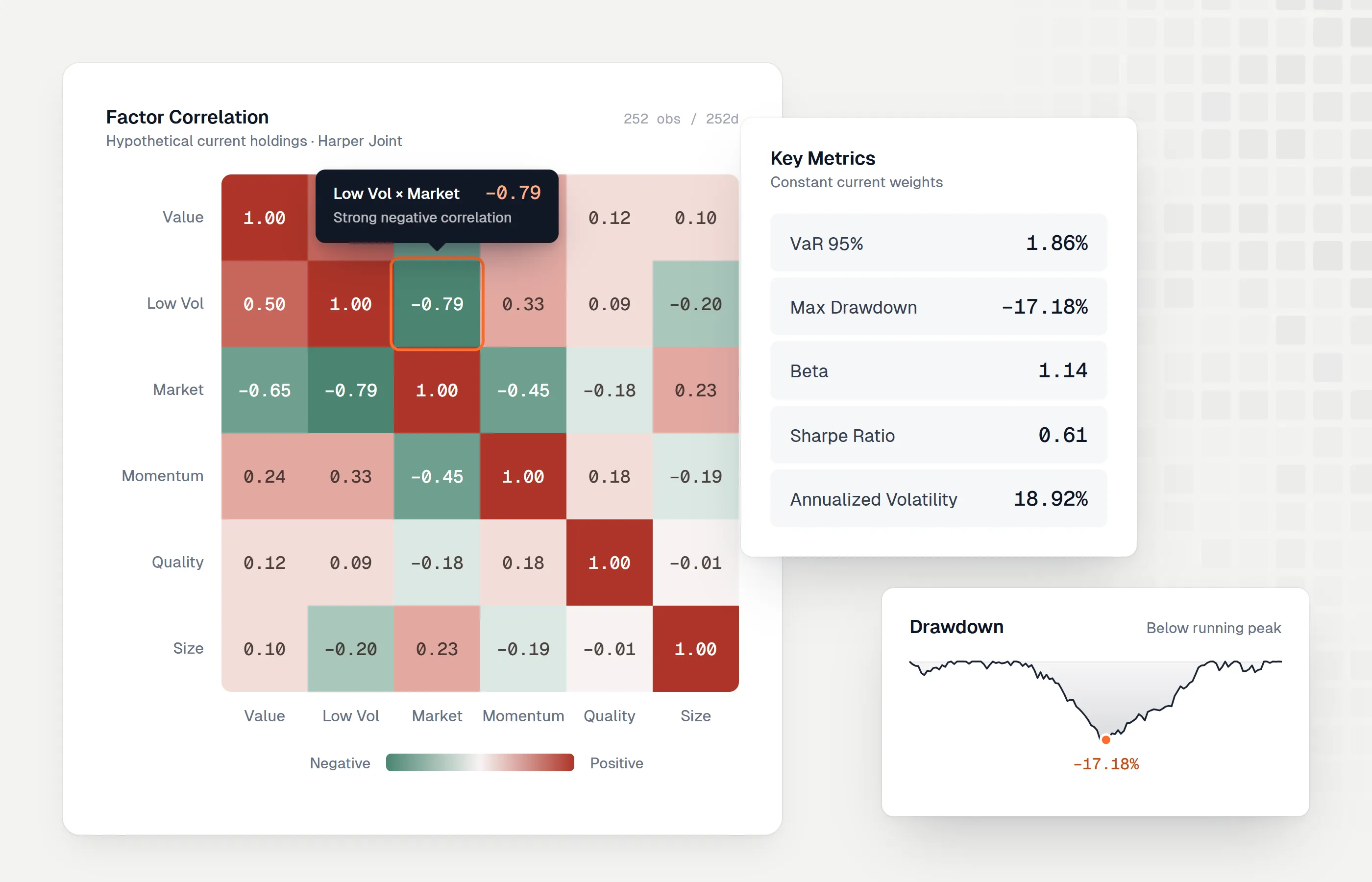
Build or review a correlation matrix of your holdings using at least 3 to 5 years of daily return data. Identify clusters of highly correlated positions that would all move against you simultaneously in a stress event.
Step 3: Decompose Your Factor Exposure
Use factor models (such as the Fama-French five-factor model or commercial risk models like Barra or Axioma) to decompose your portfolio into its underlying factor bets. This reveals whether your portfolio is unknowingly concentrated in size, style, momentum, or volatility risk.
Step 4: Run Stress Scenarios
Apply historical crisis scenarios — 2008, 2020, 2022 — to your current holdings and measure the projected drawdown. Then run hypothetical scenarios: What happens if interest rates rise 200 basis points? What if the US dollar weakens by 15%?
Step 5: Monitor Continuously
Risk is not a one-time measurement. Correlations shift, factor exposures drift as prices change, and new systematic risks emerge. Continuous monitoring is essential to maintaining accurate risk awareness.
How Genesis Risk Monitor Identifies Your Hidden Risk
This level of institutional-grade risk insight was traditionally reserved for Wall Street trading desks and hedge funds. Genesis Risk Monitor brings it directly to your workspace.
Genesis Risk Monitor uses institutional-grade Factor Exposure models and advanced analytics to show users exactly where their investment risk is coming from. By breaking down your portfolio’s systematic vulnerabilities, Genesis Risk Monitor allows you to:
- Visualise your factor exposure across size, value, momentum, and volatility dimensions
- Map real-time correlation matrices that update as market conditions change
- Run stress tests against historical and hypothetical scenarios
- Identify hidden concentration risks that surface-level sector labels miss
- Monitor risk continuously through an integrated, professional-grade dashboard
Instead of discovering your hidden bets after the market moves against you, Genesis Risk Monitor gives you the tools to see them before they materialise.
Explore Genesis Risk Monitor →
Frequently Asked Questions
What is investment risk?
Investment risk is the probability that the actual return on an investment will differ from the expected return, including the possibility of losing some or all of the original capital. Investment risk encompasses systematic risk (market-wide factors like interest rates and recessions) and unsystematic risk (company-specific events like management changes or product failures).
What is the difference between systematic and unsystematic risk?
Systematic risk affects the entire market and cannot be eliminated through diversification — examples include inflation, interest rate changes, and geopolitical events. Unsystematic risk is specific to an individual company or industry and can be reduced by holding a diversified portfolio of uncorrelated assets.
How many stocks do you need to diversify away unsystematic risk?
Academic research suggests that holding approximately 30 to 50 uncorrelated stocks captures most of the diversification benefit for eliminating unsystematic risk. However, diversification only works when the stocks are genuinely uncorrelated — holding 50 technology stocks does not provide the same benefit as holding 50 stocks across different sectors and geographies.
What is factor exposure in investing?
Factor exposure measures how sensitive a portfolio is to broad, persistent drivers of return such as company size (large-cap vs. small-cap), investment style (growth vs. value), price momentum, and volatility. Understanding factor exposure reveals the hidden systematic bets in a portfolio that sector labels alone do not capture.
Why do correlations increase during market crashes?
During severe market stress, investors sell liquid assets indiscriminately to meet margin calls, redemptions, and capital requirements. This forced selling causes assets that normally trade independently to fall together, driving correlations toward +1.0. This phenomenon is why diversification often provides less protection during a crisis than historical correlations would suggest.
How can I identify hidden risk in my portfolio?
To identify hidden portfolio risk, you should: (1) audit your sector and geographic concentration, (2) build a correlation matrix of your holdings, (3) decompose your factor exposures using quantitative models, (4) run stress tests against historical crisis scenarios, and (5) monitor these metrics continuously as market conditions evolve.
Related Reading
- How to Stress Test Your Portfolio: A Guide to Managing Investment Risk
- Understanding Value at Risk: A Practical Guide for Portfolio Managers
- What Every Beginner Should Know Before Buying Their First Stock
Disclaimer: The content of this article is for informational and educational purposes only and does not constitute financial advice, investment recommendations, or an endorsement of any specific strategy or security. Trading and investing involve substantial risk of loss and are not suitable for everyone. Past performance is not indicative of future results. Please consult with a qualified financial advisor before making any investment decisions.